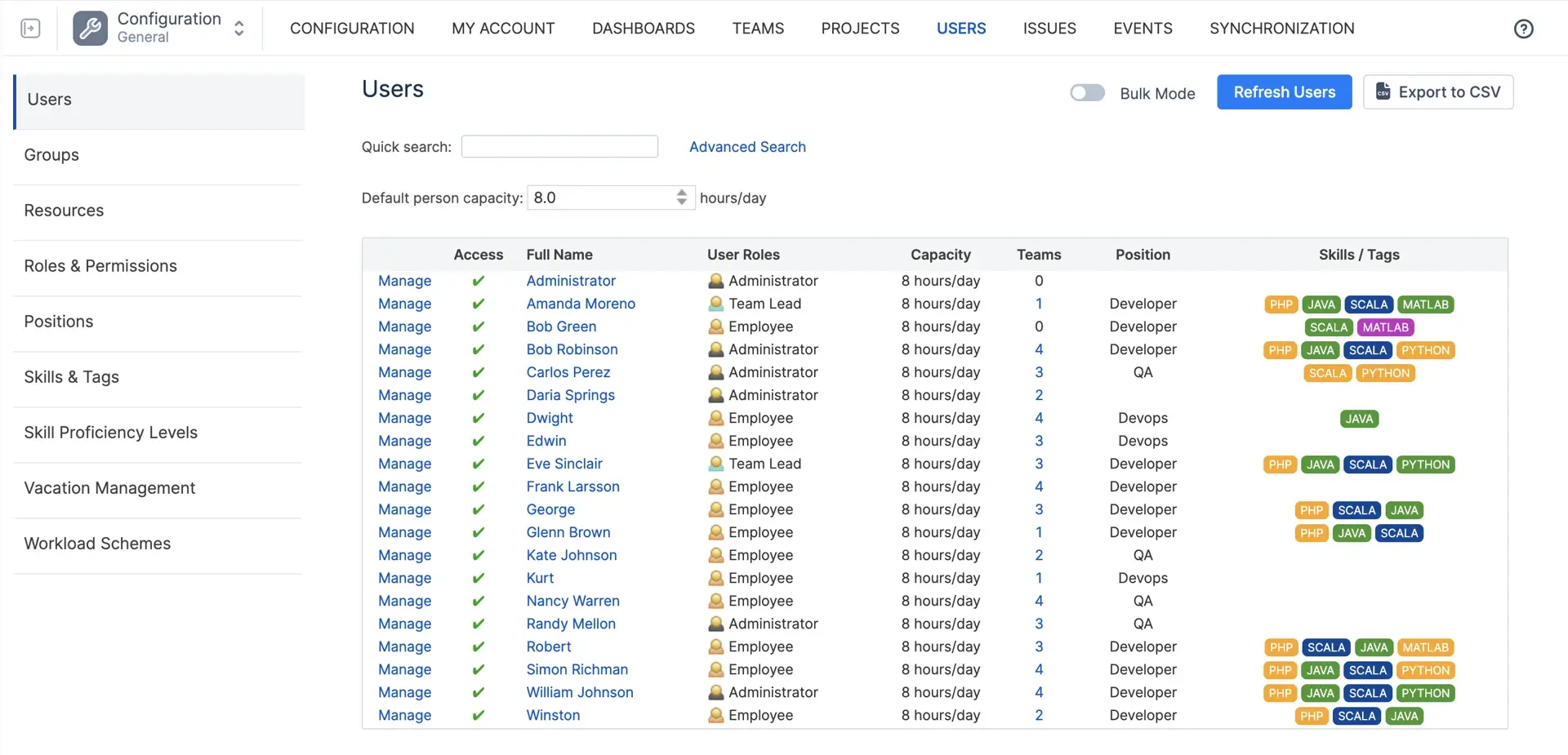
ActivityTimeline es una aplicación de planificación de recursos, por lo que la aplicación ayuda a gestionar los recursos humanos y no humanos y a planificar la actividad de los usuarios y equipos individuales.El recurso o usuario de ActivityTimeline se considera cualquier persona presente en la aplicación (básicamente, toda persona con una licencia de Jira activa). Se puede asociar a los usuarios diferentes roles, puestos y habilidades, lo que determinará sus permisos en el sistema, además de añadirles metadatos para permitir una mejor planificación de los recursos.Puedes acceder a la lista de todos tus recursos en Configuración de ActivityTimeline → Usuarios:
Resource Management
A resource is anyone you plan work for. Usually that is a person with a Jira account who shows up in ActivityTimeline automatically. It can also be someone without a Jira license (a contractor, a designer from an agency) whom you add by hand, or a non-human thing you book time on, like a test rig or a meeting room. The app treats them all the same way: each one gets a row on the timeline.
What makes a resource useful for planning is what you attach to it. A user role decides what the person can see and edit in ActivityTimeline. A position ("QA engineer", "Solution architect") describes what they do. Skills, each with a proficiency level, describe what they can do. Tags are free labels for anything else. Involvement is how many hours a day they are available, which we come back to under Capacity. None of this is required to start, but the more of it you fill in, the more the app can do for you: functional teams, skill and position availability reports, and search by skill in the Planner all depend on it.
You manage resources in ActivityTimeline Configuration → Users. If you have a lot of them, Bulk Mode edits up to 1,000 users on one page, you can remove a skill from many users at once, and Export to CSV gets the whole list into a spreadsheet. On Cloud, you can also tell the app to load users only from selected Jira groups, which keeps the list short on big instances.
What makes a resource useful for planning is what you attach to it. A user role decides what the person can see and edit in ActivityTimeline. A position ("QA engineer", "Solution architect") describes what they do. Skills, each with a proficiency level, describe what they can do. Tags are free labels for anything else. Involvement is how many hours a day they are available, which we come back to under Capacity. None of this is required to start, but the more of it you fill in, the more the app can do for you: functional teams, skill and position availability reports, and search by skill in the Planner all depend on it.
You manage resources in ActivityTimeline Configuration → Users. If you have a lot of them, Bulk Mode edits up to 1,000 users on one page, you can remove a skill from many users at once, and Export to CSV gets the whole list into a spreadsheet. On Cloud, you can also tell the app to load users only from selected Jira groups, which keeps the list short on big instances.
Administración de equipos
El concepto de equipo es bastante sencillo en ActivityTimeline, que es esencialmente un grupo de personas unidas en una sola entidad.
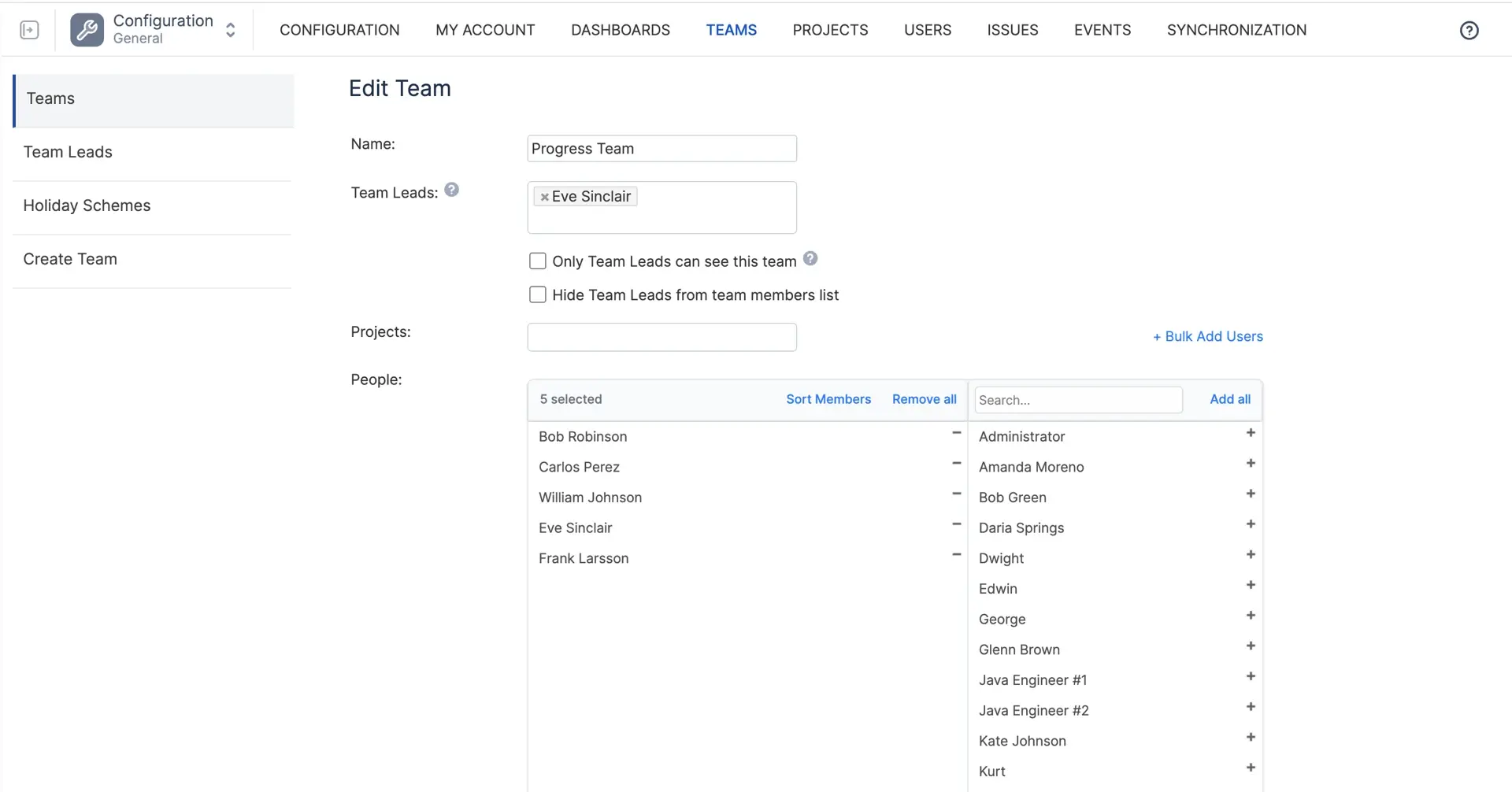
A classic team is one you assemble by hand: pick the people, save, done. You add and remove members whenever you like, and you can hand that job to a team lead so it stops landing on the Jira admin. This is the right choice when membership is a management decision, like a project team or a squad.
A classic team is one you assemble by hand: pick the people, save, done. You add and remove members whenever you like, and you can hand that job to a team lead so it stops landing on the Jira admin. This is the right choice when membership is a management decision, like a project team or a squad.
A functional team builds itself from user attributes. You choose a skill or a position, and everyone with that skill or position is in the team, now and in the future. If you hire a third Java developer next month and give them the Java skill, they appear in the "Java" team without anyone editing it. This is the right choice when membership follows what people can do rather than who they report to. The catch is that it only works if skills and positions are actually maintained, so decide who owns that before you rely on it.
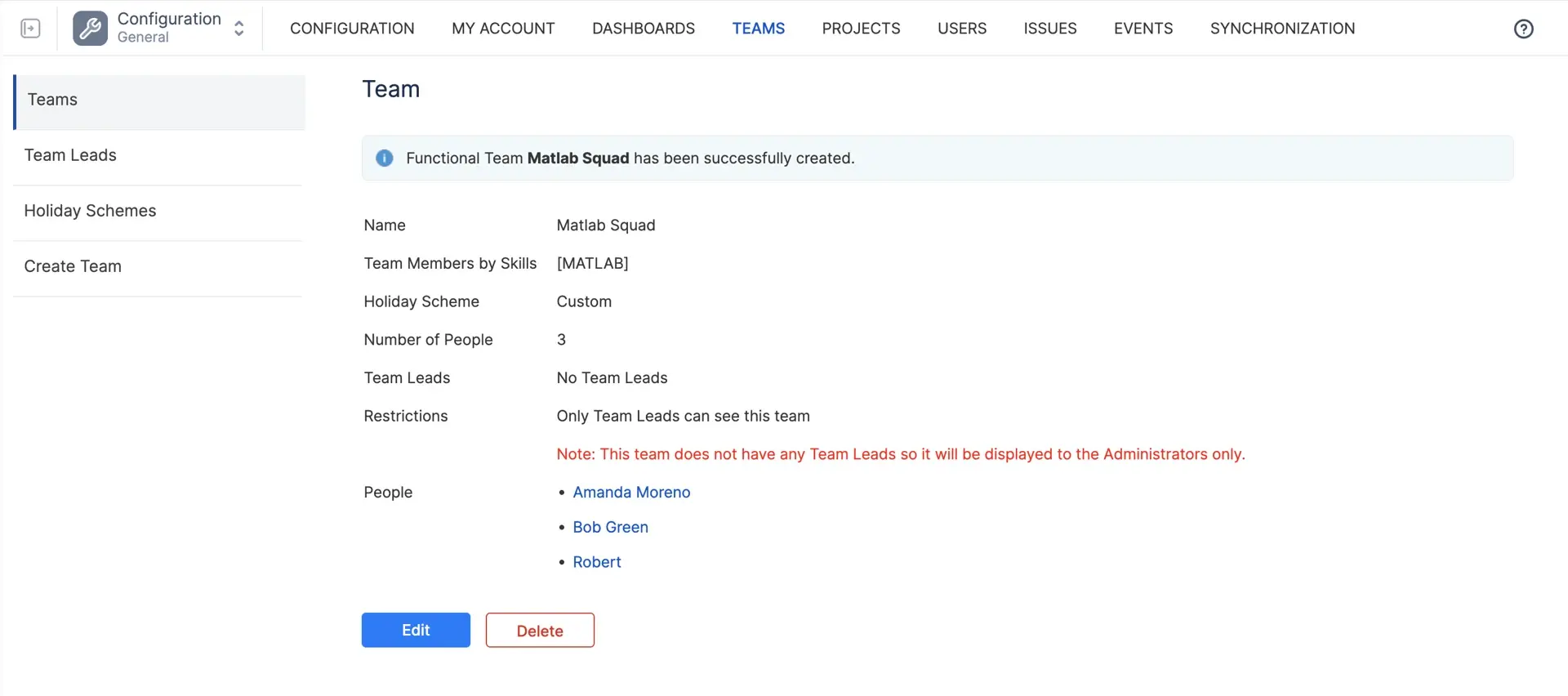
Básicamente, eso es todo, cuando tienes tus equipos configurados y listos, puedes planificar sus actividades, hacer un seguimiento del progreso e informar para ver el panorama general.
A few small things that make teams nicer to live with: you can order the members inside a team the way you want them to appear on the Planner (by role, by seniority, whatever helps the planning meeting), and a day off or a note can be created for the entire team at once instead of person by person, which is handy for company events and offsites.
A few small things that make teams nicer to live with: you can order the members inside a team the way you want them to appear on the Planner (by role, by seniority, whatever helps the planning meeting), and a day off or a note can be created for the entire team at once instead of person by person, which is handy for company events and offsites.
Cronología personal
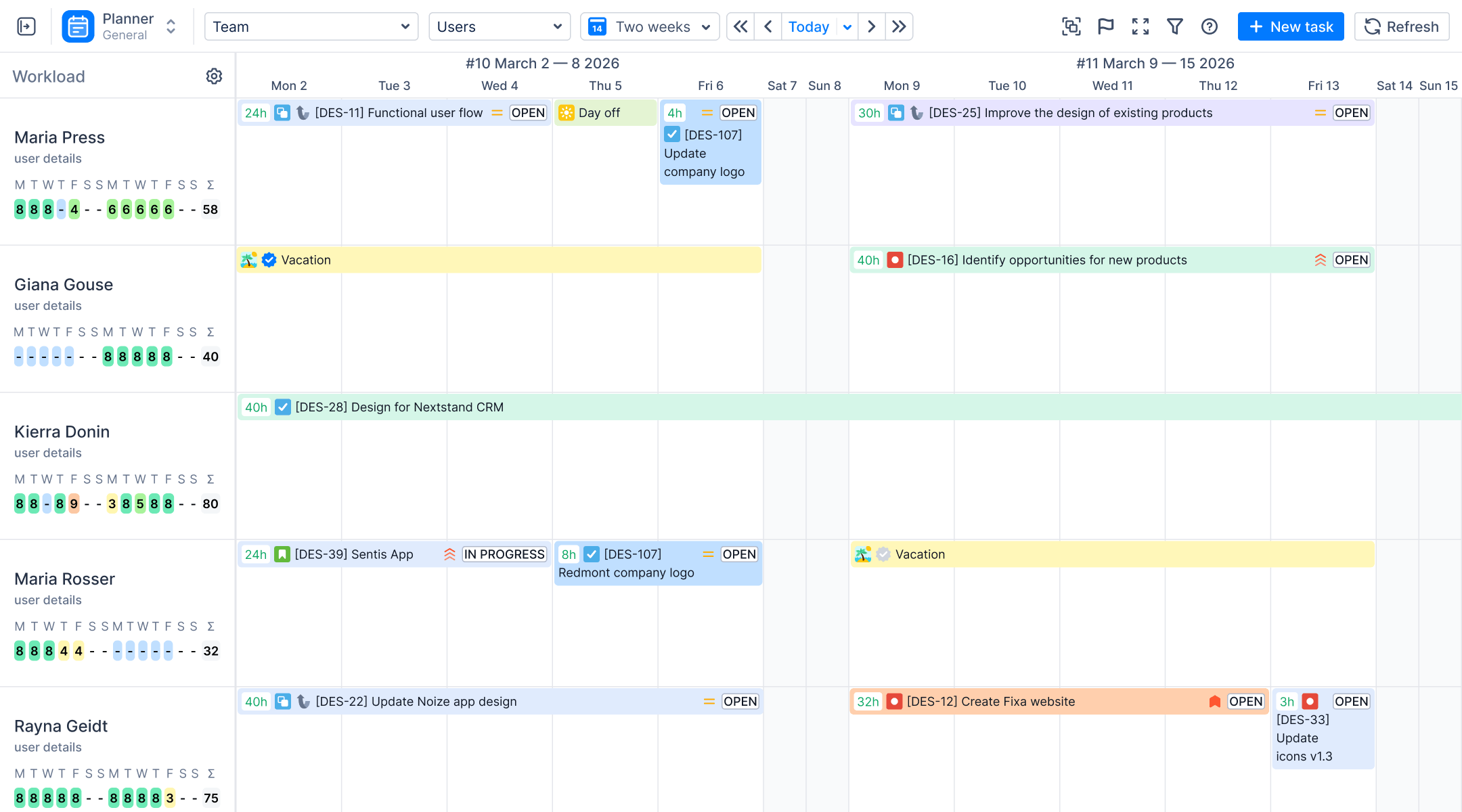
Como software avanzado de planificación de recursos, ActivityTimeline lleva este concepto a un nivel superior, permitiendo mostrar los recursos (usuarios y equipos individuales) en una dimensión temporal, teniendo en cuenta la carga de trabajo y las limitaciones de capacidad de los recursos disponibles.
Under the person's name you see the workload indicator, a small number per day (or per week and month when you zoom out) that says how many hours are planned against how many they have. The color tells you at a glance what to do about it: yellow and olive mean there is room for more, green means the day is full, light red and red mean too much has been planned and something has to move, blue means the person is out (day off, vacation, sick leave, holiday), and grey means nothing is planned. The thresholds behind the colors are configurable under Configuration → Workload Indicator, so if your team considers 6 planned hours a full day, you can say so.
Under the person's name you see the workload indicator, a small number per day (or per week and month when you zoom out) that says how many hours are planned against how many they have. The color tells you at a glance what to do about it: yellow and olive mean there is room for more, green means the day is full, light red and red mean too much has been planned and something has to move, blue means the person is out (day off, vacation, sick leave, holiday), and grey means nothing is planned. The thresholds behind the colors are configurable under Configuration → Workload Indicator, so if your team considers 6 planned hours a full day, you can say so.
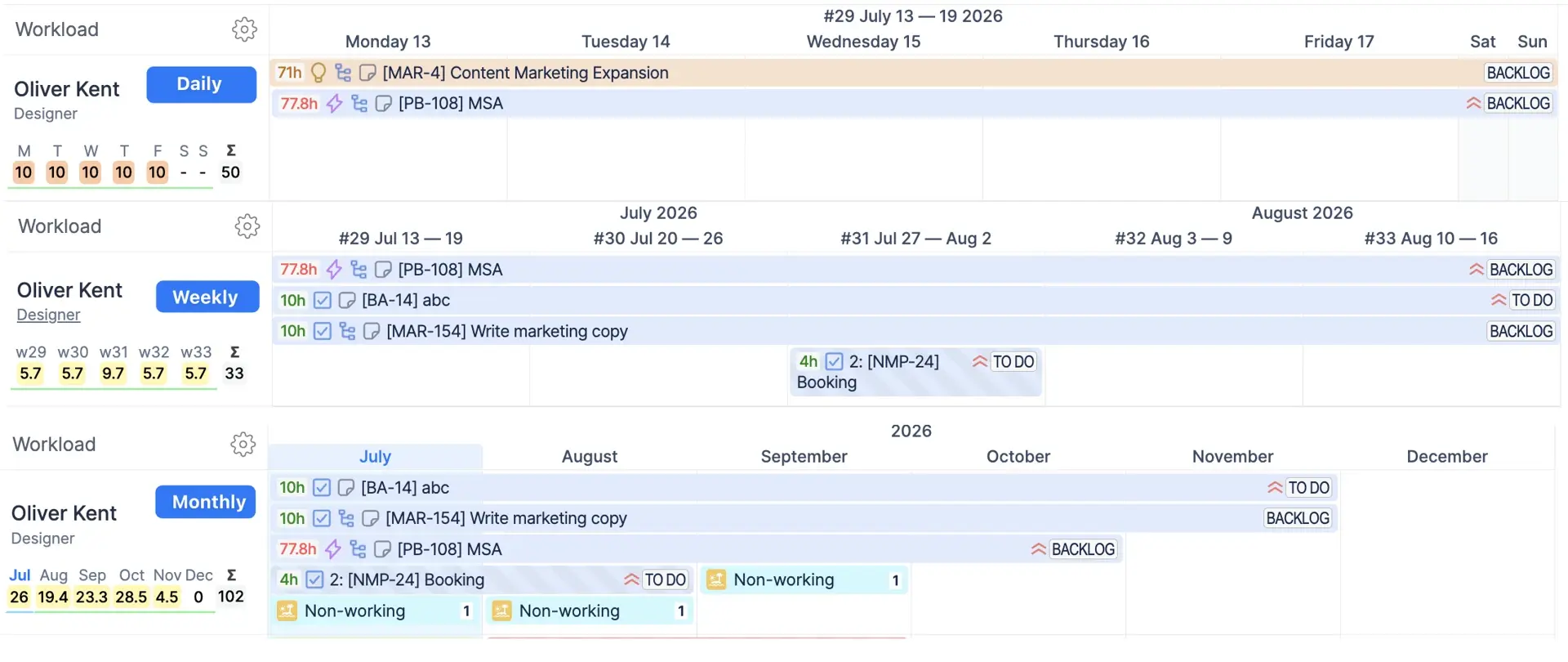
Debajo del nombre de cada recurso, puedes ver el indicador de carga de trabajo y mostrar la cantidad de horas asignadas a una persona durante un período específico. Esto depende de la estimación de las tareas asociadas y de los eventos personalizados que estén programados en su cronograma. Los diferentes colores del indicador muestran la carga que tiene una persona en comparación con su capacidad (implicación):
Cronología del equipo
Esta funcionalidad amplía el concepto de cronograma y permite planificar los elementos de trabajo para todo el equipo en general sin entrar en detalles. Esto es particularmente útil cuando se planifica para períodos más largos cuando el nivel de certeza no es alto.
The selector on the Planner top panel switches between three views. Users shows individual timelines only. Teams shows one row per team.
The selector on the Planner top panel switches between three views. Users shows individual timelines only. Teams shows one row per team.
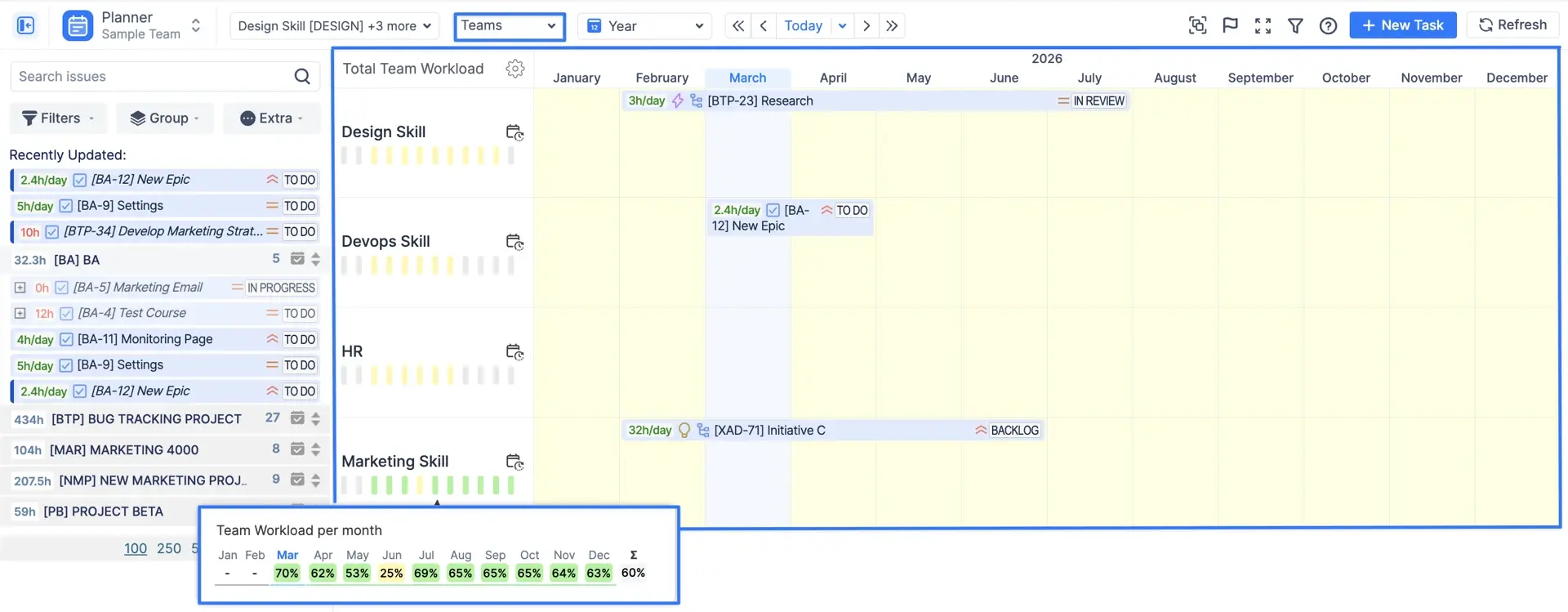
Team with Users shows the team row on top and the members underneath, so you can see the unassigned team-level work and each person's load in one screen. Team-level assignments are counted in the reports too: the Team Capacity Chart and the utilization forecasts can include or exclude team panel workload, so you can look at a team as a whole or drill down to the people.
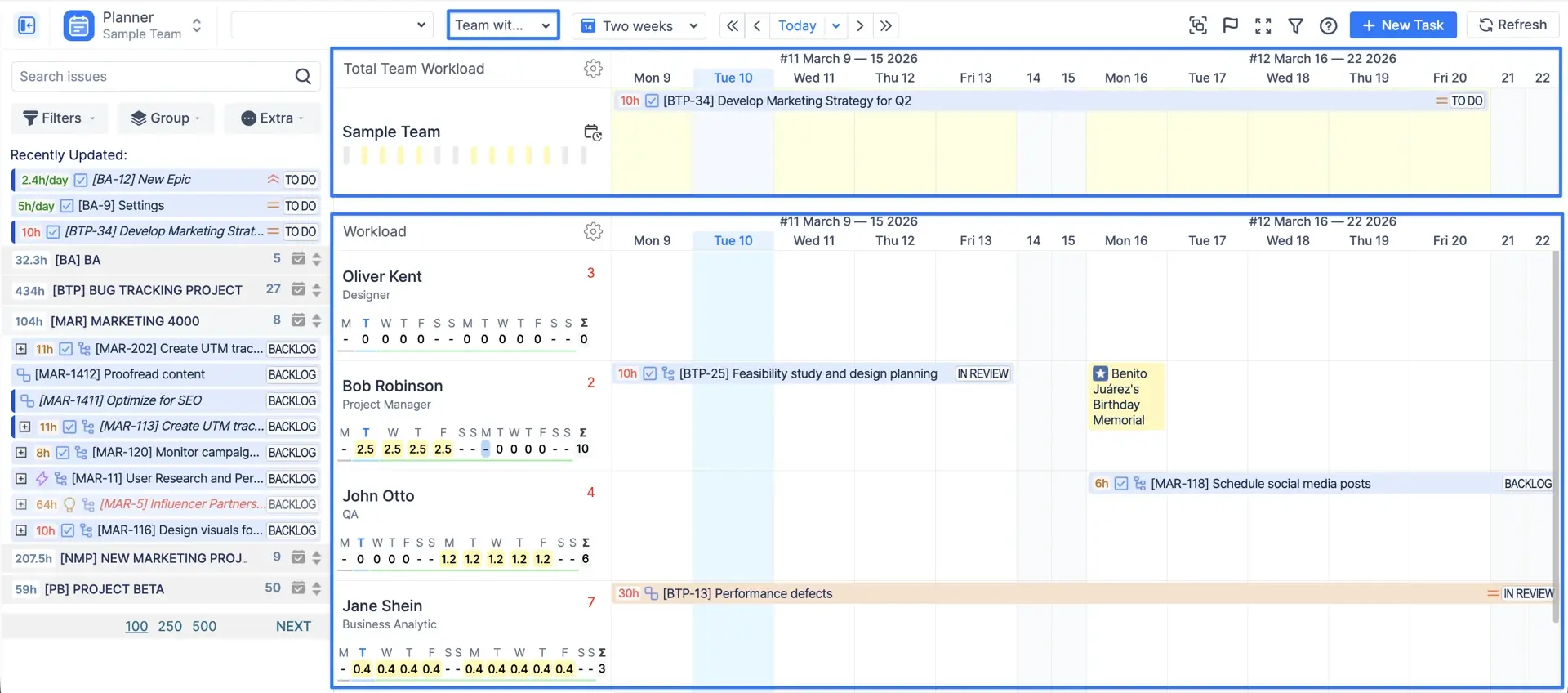
You can check the detailed guide on the Team panel in our documentation: Team panel
Tareas de Jira
Planificación sencilla de tareas en Jira. Todas las tareas de los proyectos habilitados se cargan desde tu instancia de Jira a ActivityTimeline durante la configuración inicial y los usuarios con los permisos necesarios pueden acceder a ellas para planificarlas.
The panel on the left of the Planner is the backlog you plan from. One thing to know up front: by default it lists issues updated in the last 30 days, so if an old issue seems to be missing, add a filter and it will appear. Filters can include or exclude projects, sprints, assignees, statuses and custom fields, and you can search by key or text. Once you have found an issue, you drag it onto a timeline.
The panel on the left of the Planner is the backlog you plan from. One thing to know up front: by default it lists issues updated in the last 30 days, so if an old issue seems to be missing, add a filter and it will appear. Filters can include or exclude projects, sprints, assignees, statuses and custom fields, and you can search by key or text. Once you have found an issue, you drag it onto a timeline.
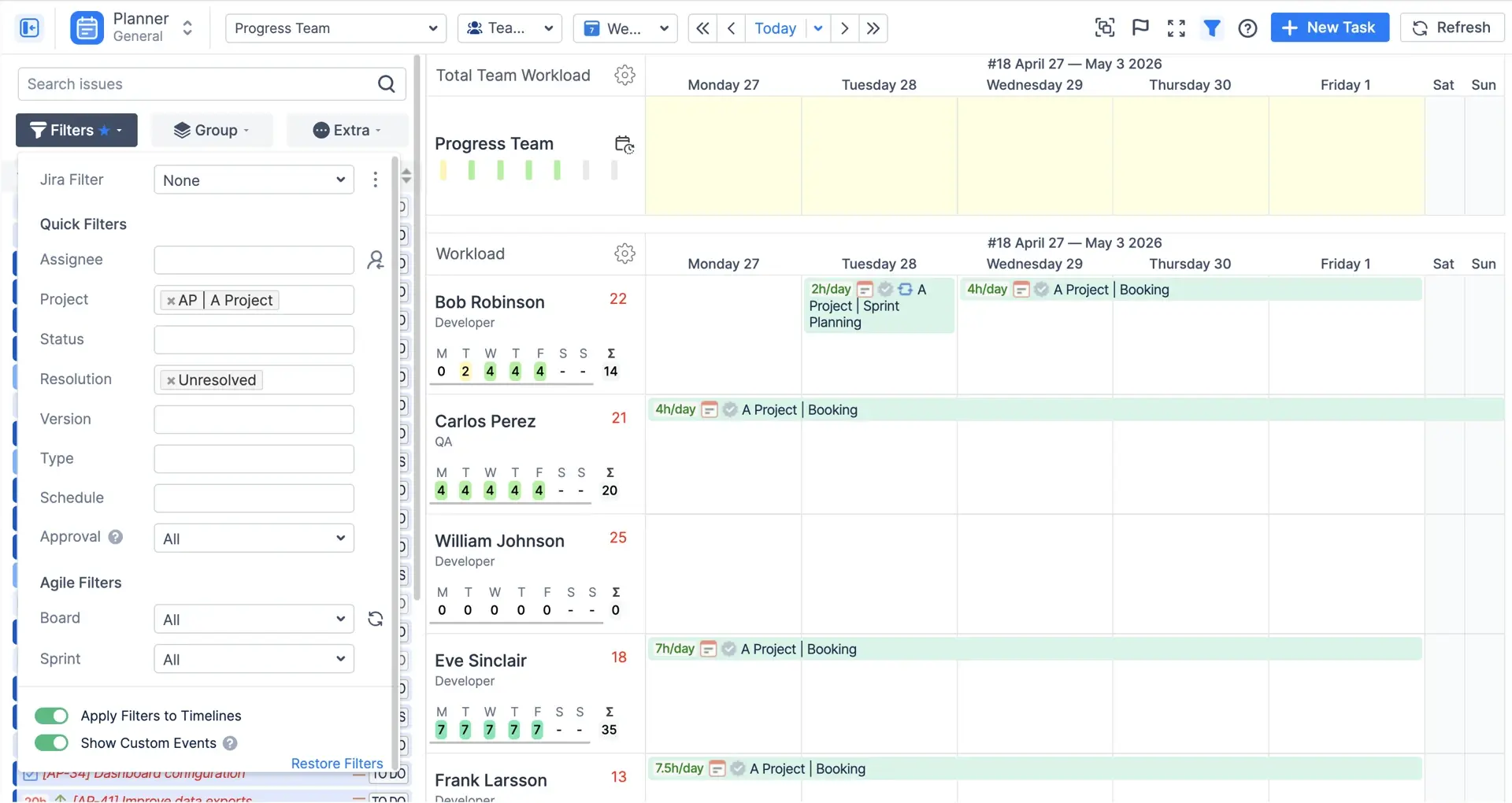
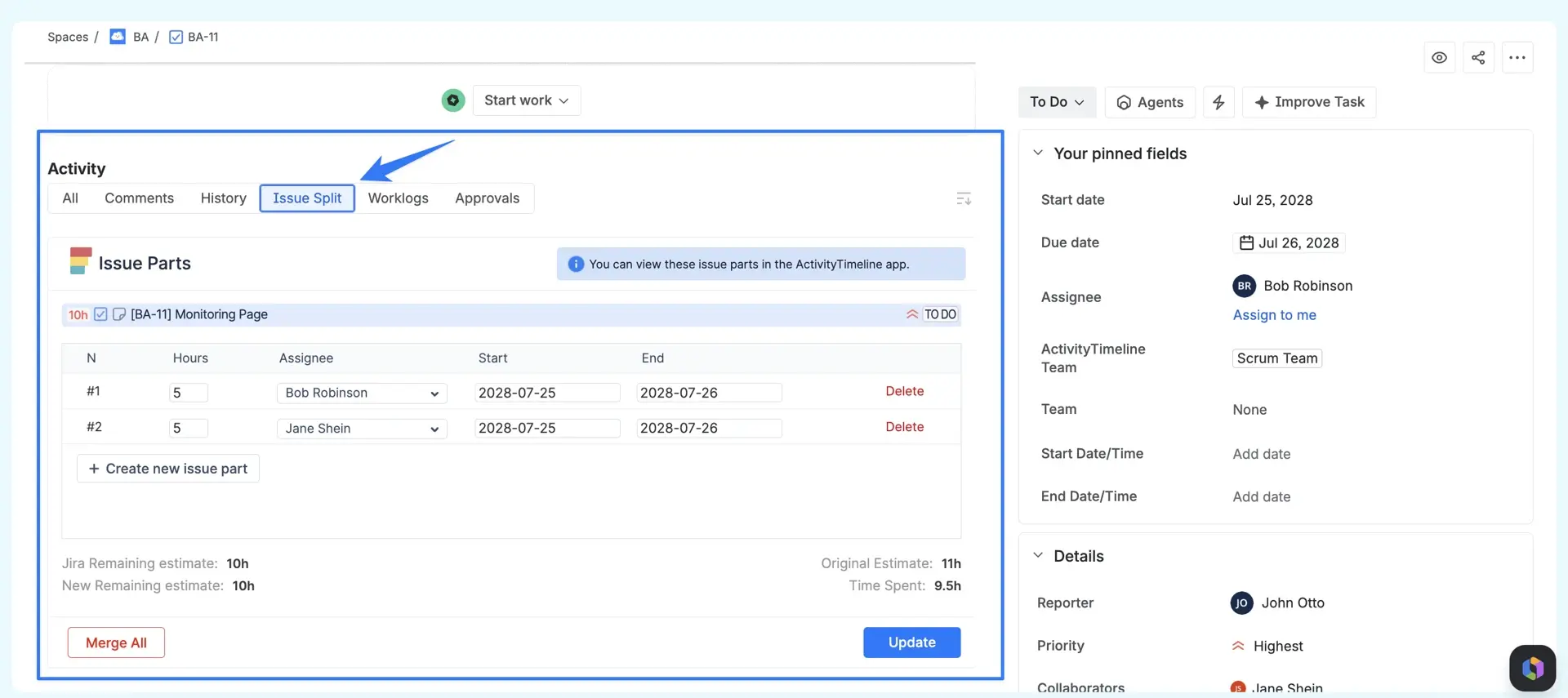
Cada incidencia está representada por una barra individual, que tiene un conjunto de atributos que describen esta tarea (es decir, prioridad, tipo de incidencia, estimación, etc.). Sin embargo, la apariencia es personalizable y se puede ajustar según las necesidades de los usuarios en Menú Configuración→ Incidencias:
Eventos locales
Además de los eventos estándar de Jira, ActivityTimeline también tiene un conjunto de eventos personalizados que proporcionan algunas funciones adicionales y cubren casos que, por lo general, no se admiten en las incidencias de Jira.
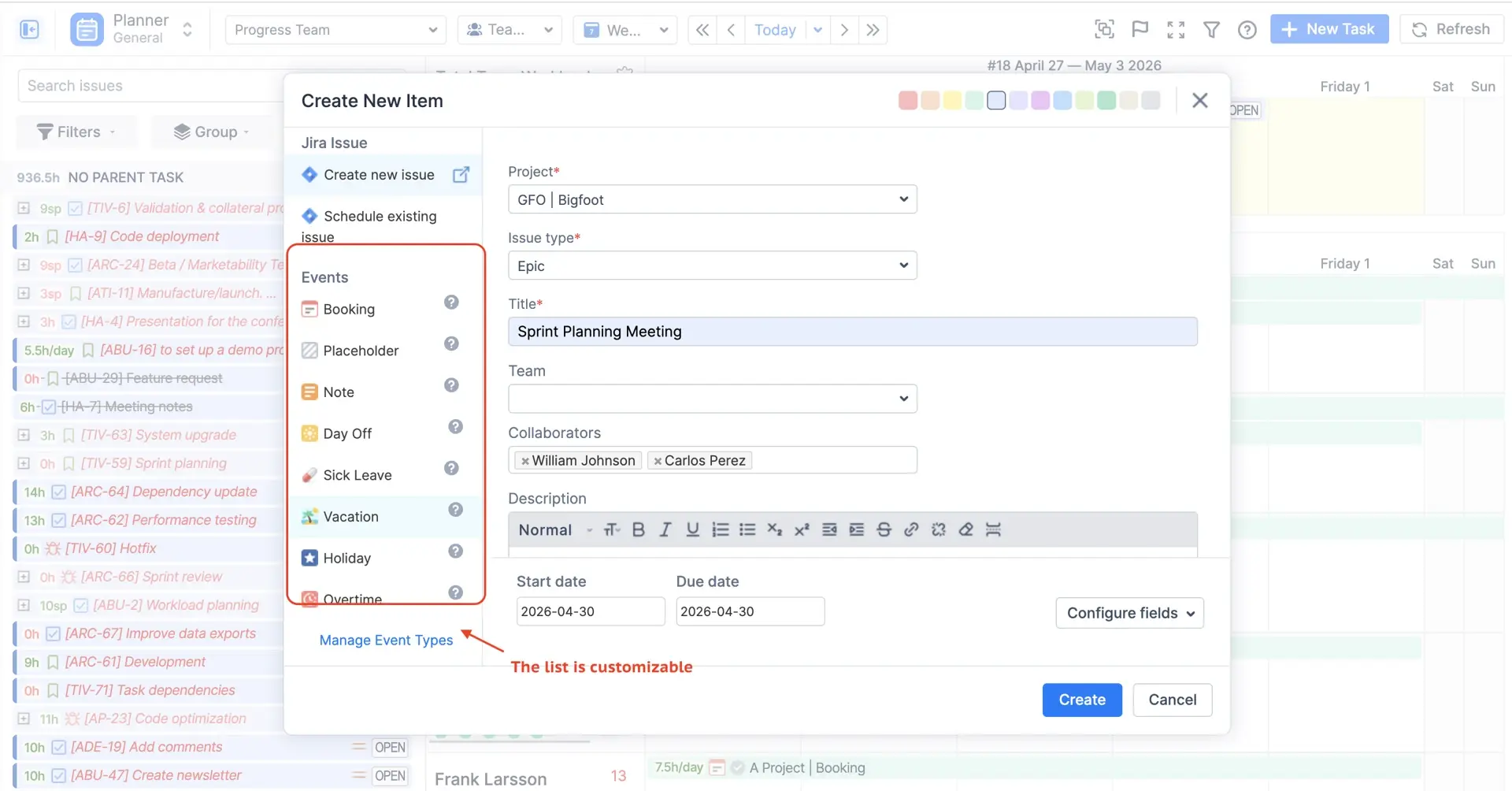
Los usuarios pueden crear eventos personalizados que estén disponibles en ActivityTimeline: reserva, día libre, festivo, nota, horas extras, marcador de posición, baja por enfermedad y vacaciones. Además de estos eventos, puedes crear tus eventos en función de los tipos de eventos del sistema, como una reserva, un día libre, etc., lo que te brinda aún más flexibilidad en términos de planificación.
- Booking takes hours away every day it covers, which is how you reserve someone for a project before the tickets exist.
- Overtime adds hours, for the days when extra time is agreed in advance and you do not want the person to show as overloaded.
- Day Off, Vacation, Sick Leave and Holiday remove the day, or part of it: a day off can be a full day or a set number of hours, and holidays usually come from a holiday scheme so you are not entering Christmas by hand for every country.
- Note does nothing to capacity; it is a text reminder on the timeline.
- Placeholder is the odd one out: it is a "what if" item. Use placeholders to try a plan without touching Jira, and when the plan is agreed, approve the placeholder and it turns into a real Jira issue, description included.
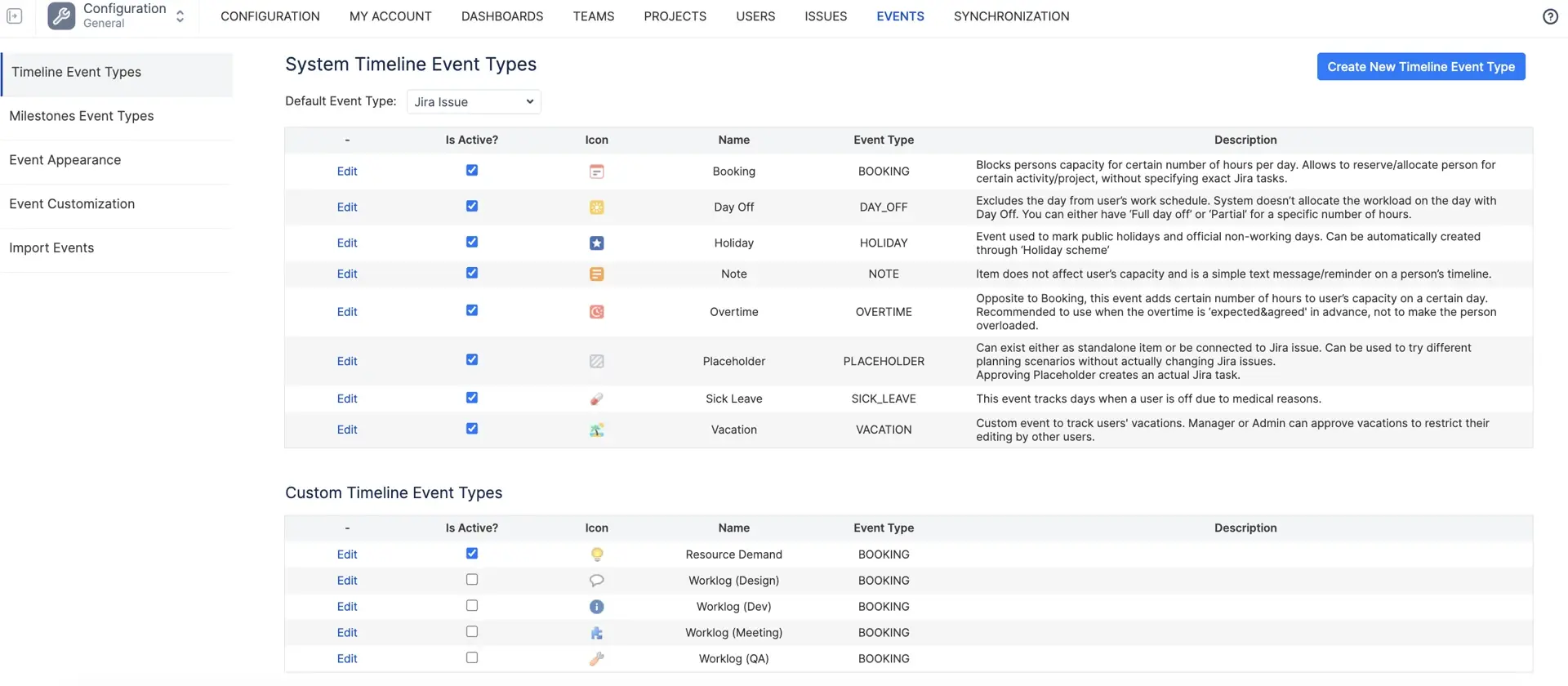
You can also make your own event types based on these eight (a "Training" event that behaves like a booking, say), and you decide per type whether it needs approval. Vacation used to require approval always; now that is a setting, and the same goes for bookings, placeholders, days off and sick leave.
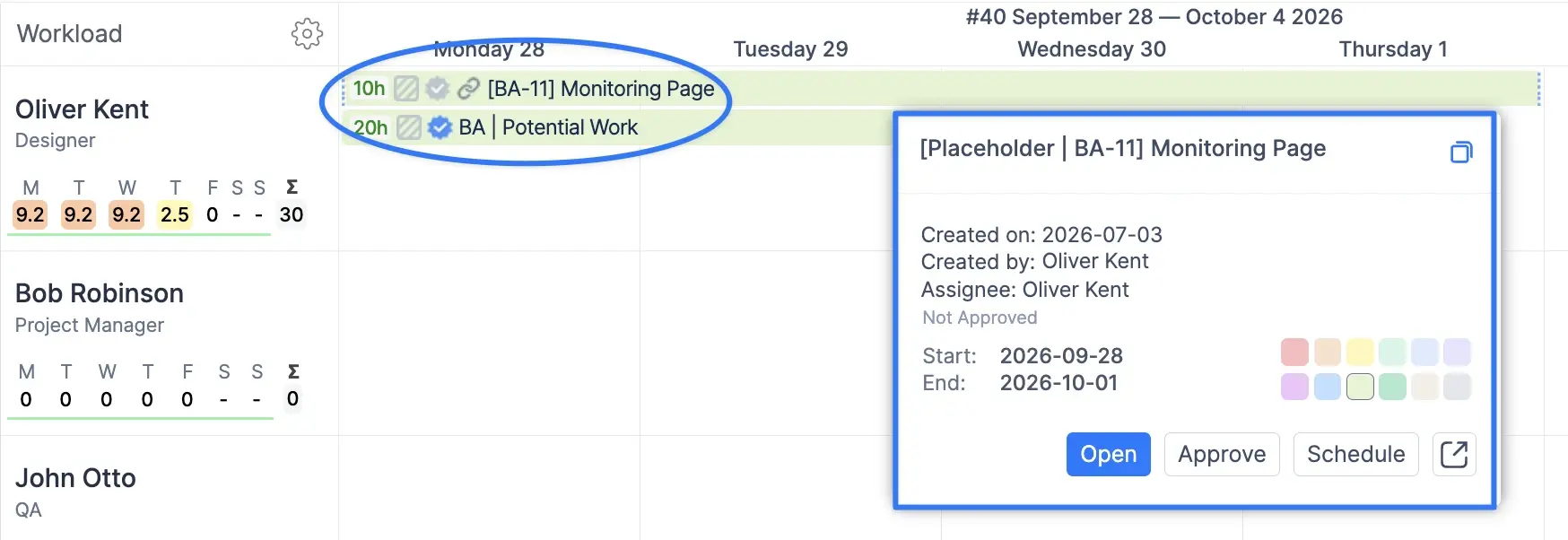
If your team keeps its meetings in Google Calendar or Outlook, those can be imported and shown on the timeline as events as well, so a Tuesday full of calls looks full. Whether imported events count as logged time or are shown just for context is a setting in the timesheet configuration.
Administración de cargas de trabajo
Hay diferentes interpretaciones de lo que es la carga de trabajo, pero en pocas palabras, se trata simplemente de la cantidad de trabajo estimada que se ha asignado a un recurso durante un período de tiempo específico. ActivityTimeline está diseñado específicamente para permitir la asignación adecuada de la carga de trabajo entre los recursos y garantizar que todos los recursos se utilicen al máximo, pero no se sobrecarguen.
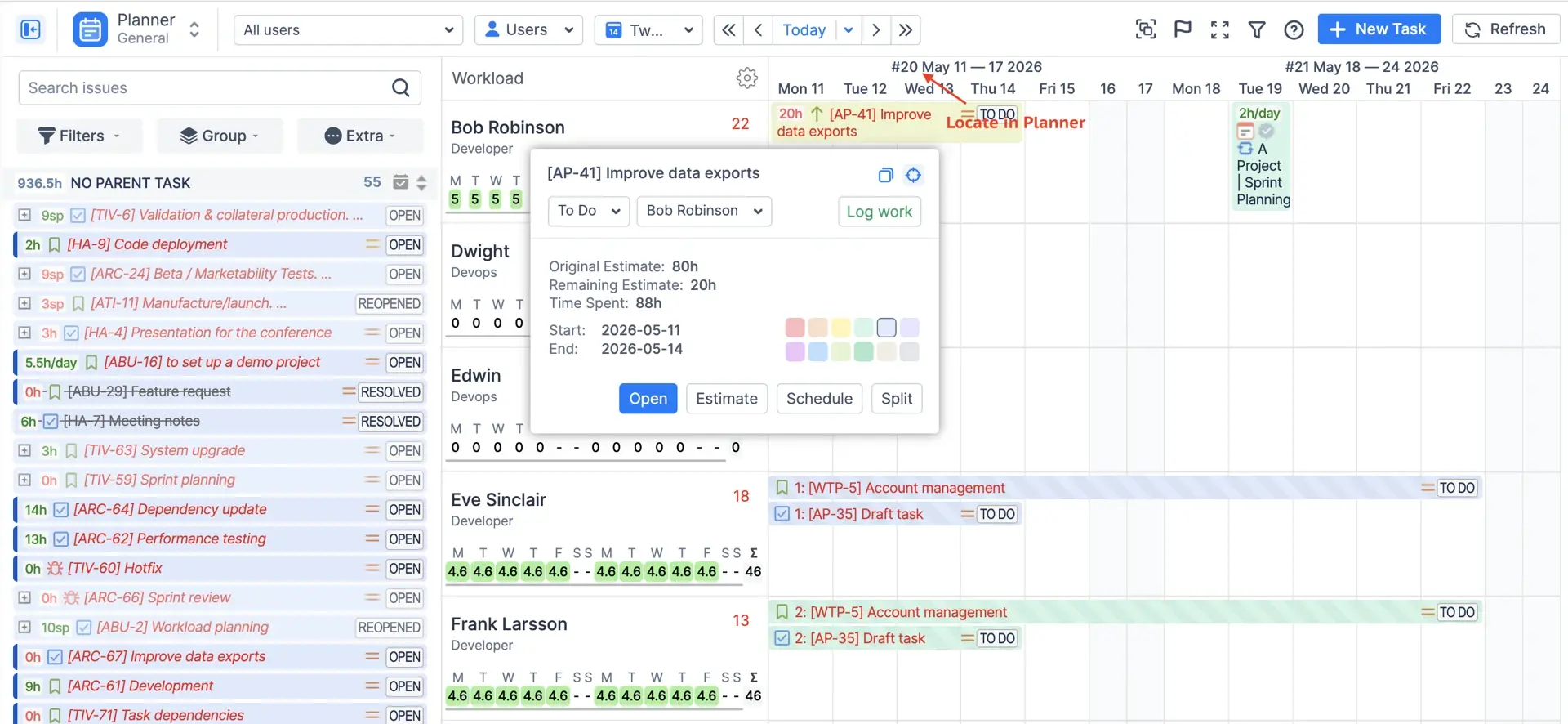
One consequence worth stating plainly: an issue with no estimate adds nothing to the workload. It will sit on the timeline and the indicator under the person will stay yellow. If you see a full-looking timeline and a relaxed indicator, missing estimates are almost always why.
One consequence worth stating plainly: an issue with no estimate adds nothing to the workload. It will sit on the timeline and the indicator under the person will stay yellow. If you see a full-looking timeline and a relaxed indicator, missing estimates are almost always why.

Puedes obtener más información sobre el indicador de carga de trabajo en nuestra documentación:
You can learn more about the workload indicator in our documentation: indicador de carga de trabajo
You can learn more about the workload indicator in our documentation: indicador de carga de trabajo
Administración de la capacidad
La planificación de la capacidad de los recursos en Jira resulta sencilla con ActivityTimeline. Para saber si la persona está sobrecargada, subcargada o si la cantidad de trabajo es simplemente perfecta, es necesario definir la capacidad del recurso o, como lo llamamos nosotros: Implicación.Esto se puede configurar para la organización en su conjunto o individualmente para cada recurso y para cada día.
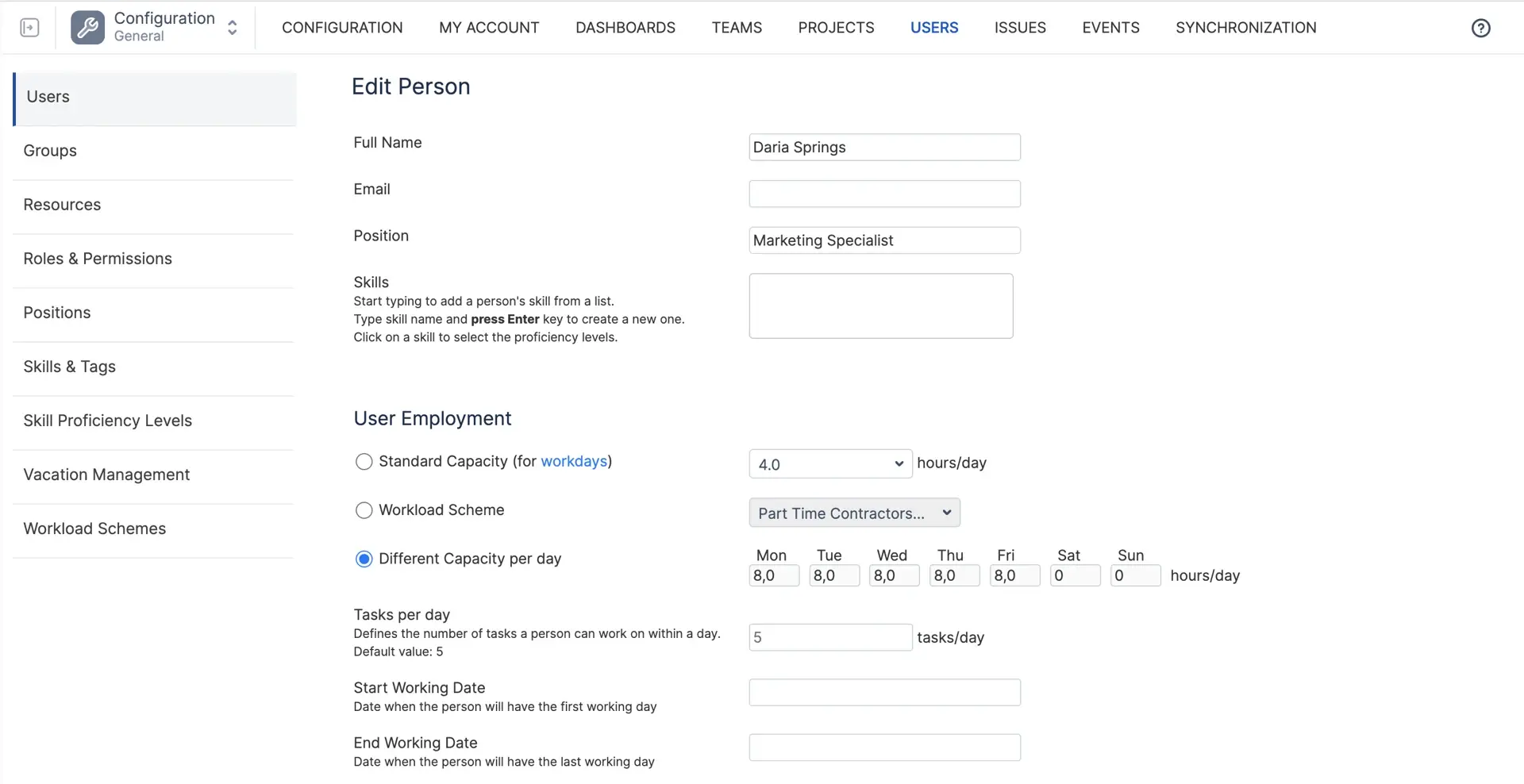
Al calcular la carga de trabajo del recurso, el sistema comparará la cantidad de trabajo asignada a la persona en un período y determinará si el recurso está sobrecargado, subcargado o si tiene una carga de trabajo nominal.
The comparison of workload against capacity is what colors the indicator: below capacity is yellow or olive, at capacity is green, above it is light red or red. Vacation balances have their own cycle, and you can set when that cycle starts, globally or per person, so it lines up with your HR calendar rather than the January default.
The comparison of workload against capacity is what colors the indicator: below capacity is yellow or olive, at capacity is green, above it is light red or red. Vacation balances have their own cycle, and you can set when that cycle starts, globally or per person, so it lines up with your HR calendar rather than the January default.
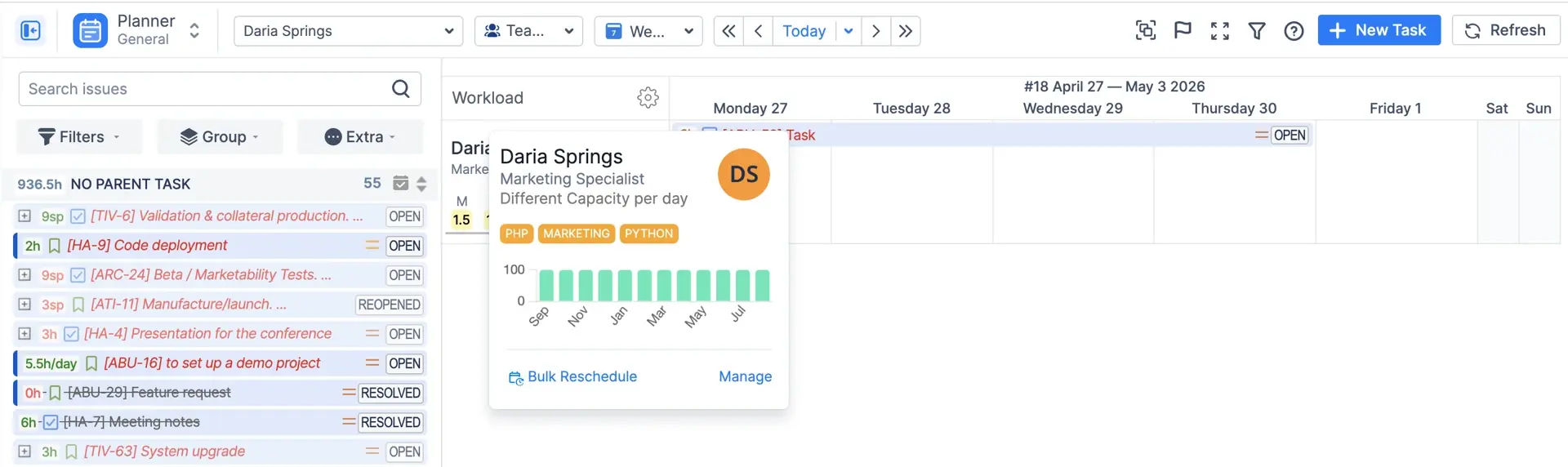
Puedes gestionar la implicación individual de cada recurso en su perfil:
Seguimiento del tiempo de Jira (registros de trabajo)
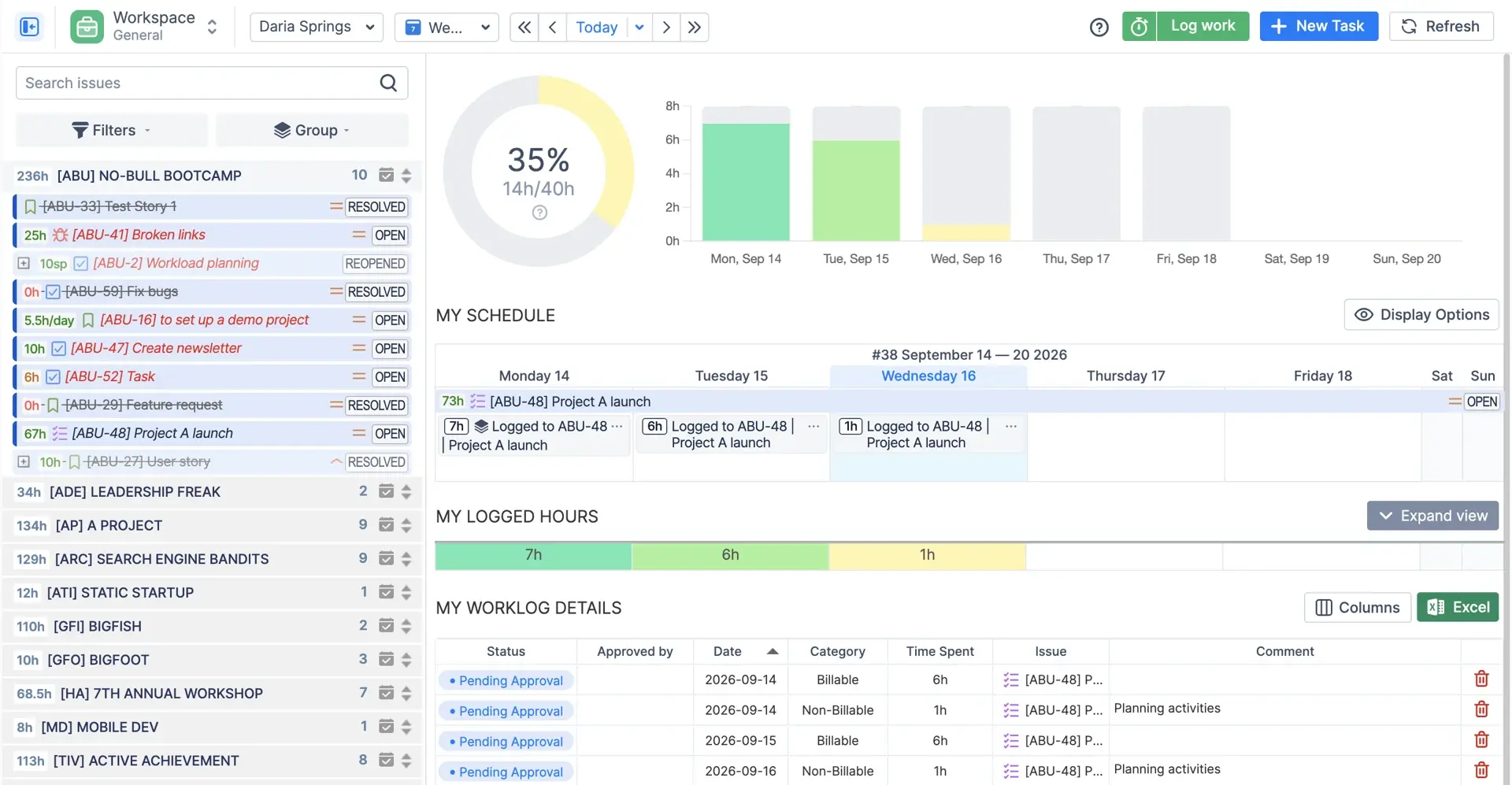
Los registros de trabajo son entradas de tiempo que los usuarios enviaron a las tareas de Jira mientras trabajaban en ellas. ActivityTimeline las sincroniza desde Jira y permite registrar el tiempo directamente a través de su interfaz de usuario.
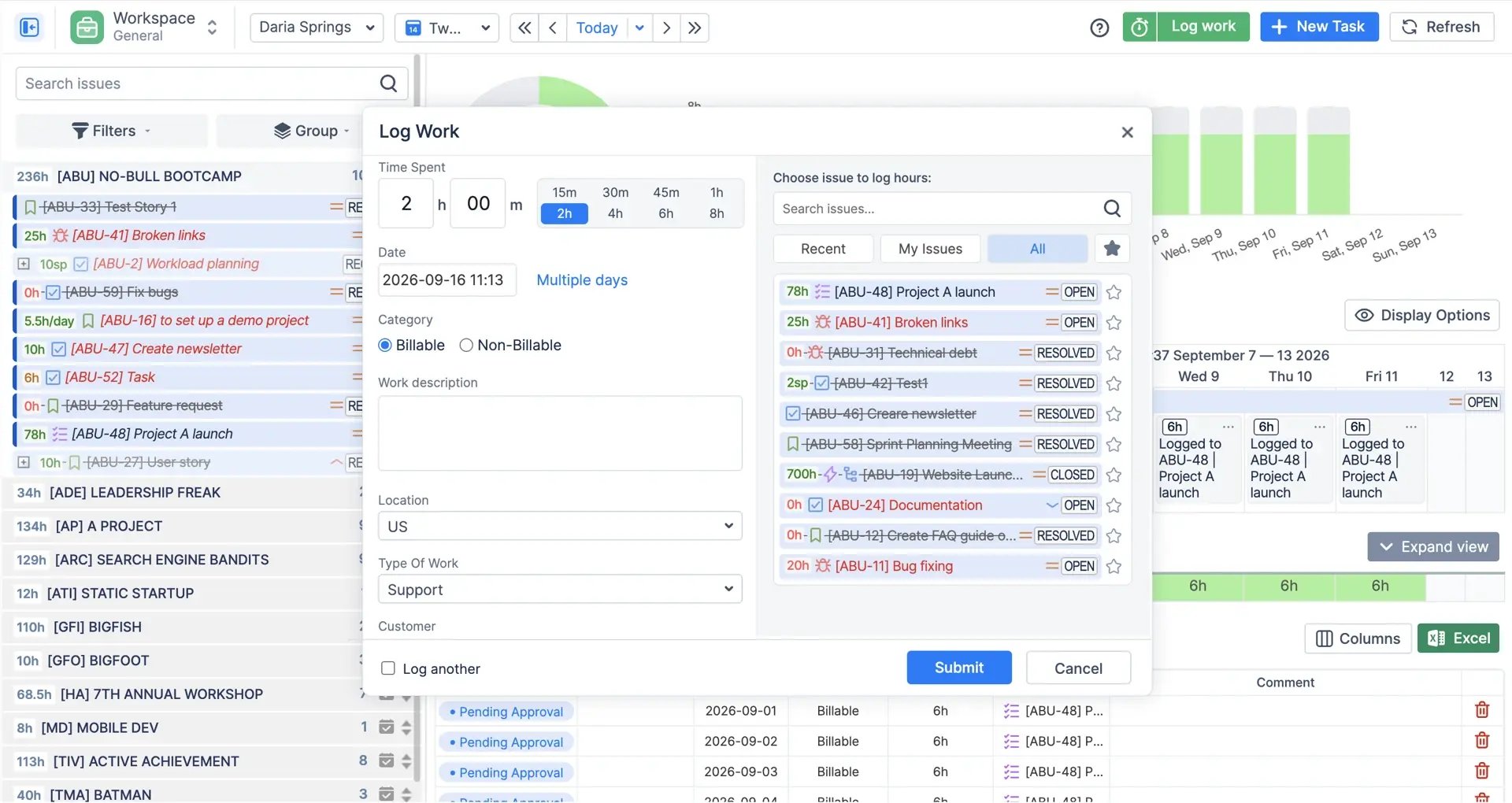
Worklogs can carry more than a number: a category (billable or not, say) and custom attributes your finance team asks for. Admins can limit how far back someone may log, with options from a few days to 75, which matters if you close books monthly.
Where worklogs show up: the Timesheets module is the main place, with filters that separate Jira worklogs from bookings and calendar events. On the Planner, the default indicator mode called Worklogs & Workload shows logged time for the past and planned time for the future in the same row, which is the fastest way to see whether the plan matched reality. That comparison, planned against actual, is what makes estimates get better over time: if a type of task is always logged at twice its estimate, you will see it within a few sprints.
Where worklogs show up: the Timesheets module is the main place, with filters that separate Jira worklogs from bookings and calendar events. On the Planner, the default indicator mode called Worklogs & Workload shows logged time for the past and planned time for the future in the same row, which is the fastest way to see whether the plan matched reality. That comparison, planned against actual, is what makes estimates get better over time: if a type of task is always logged at twice its estimate, you will see it within a few sprints.
Si tienes alguna pregunta adicional relacionada con la siguiente sección, no dudes en ponerte en contacto con nuestro equipo en:
How it all fits together
Everything above reduces to three numbers per person per day. Capacity is how much time they have. Workload is how much you have planned for them. Worklogs are how much they actually spent. Workload against capacity tells you whether the plan is realistic. Worklogs against workload tells you whether your estimates were.
Resources and teams are who those numbers belong to, personal and team timelines are where you see them, and Jira tasks and custom events are what produces them. That is the whole model. Most teams never need more than this, and the teams that do (finance modules, forecasts by skill, REST API) find it two or three clicks further in.
If something on this page does not match what you see in your instance, tell us at reliex.com/support. This page gets updated when the app does, and a fair share of those updates started as a support ticket.
Resources and teams are who those numbers belong to, personal and team timelines are where you see them, and Jira tasks and custom events are what produces them. That is the whole model. Most teams never need more than this, and the teams that do (finance modules, forecasts by skill, REST API) find it two or three clicks further in.
If something on this page does not match what you see in your instance, tell us at reliex.com/support. This page gets updated when the app does, and a fair share of those updates started as a support ticket.

Try it with your own Jira. The trial is 30 days, no credit card, and the setup wizard walks you through the same concepts in the same order as this page.