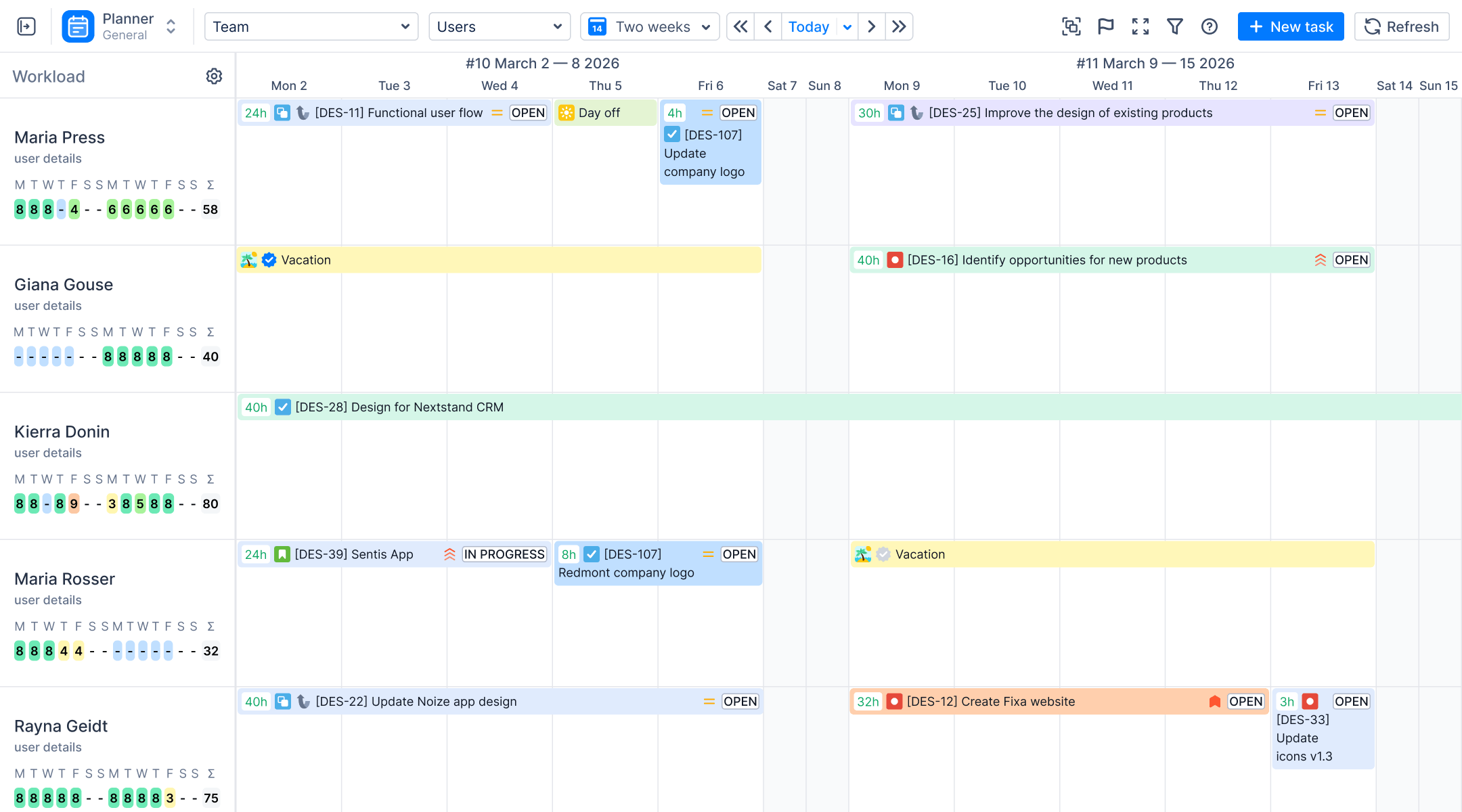
O ActivityTimeline é um aplicativo de planejamento de recursos, portanto, o aplicativo ajuda a gerenciar recursos humanos e não humanos, planejar a atividade de usuários e equipes individuais.
If you prefer to click around first, the Quick Start Guide walks through the same concepts as steps.
If you prefer to click around first, the Quick Start Guide walks through the same concepts as steps.
Resource Management
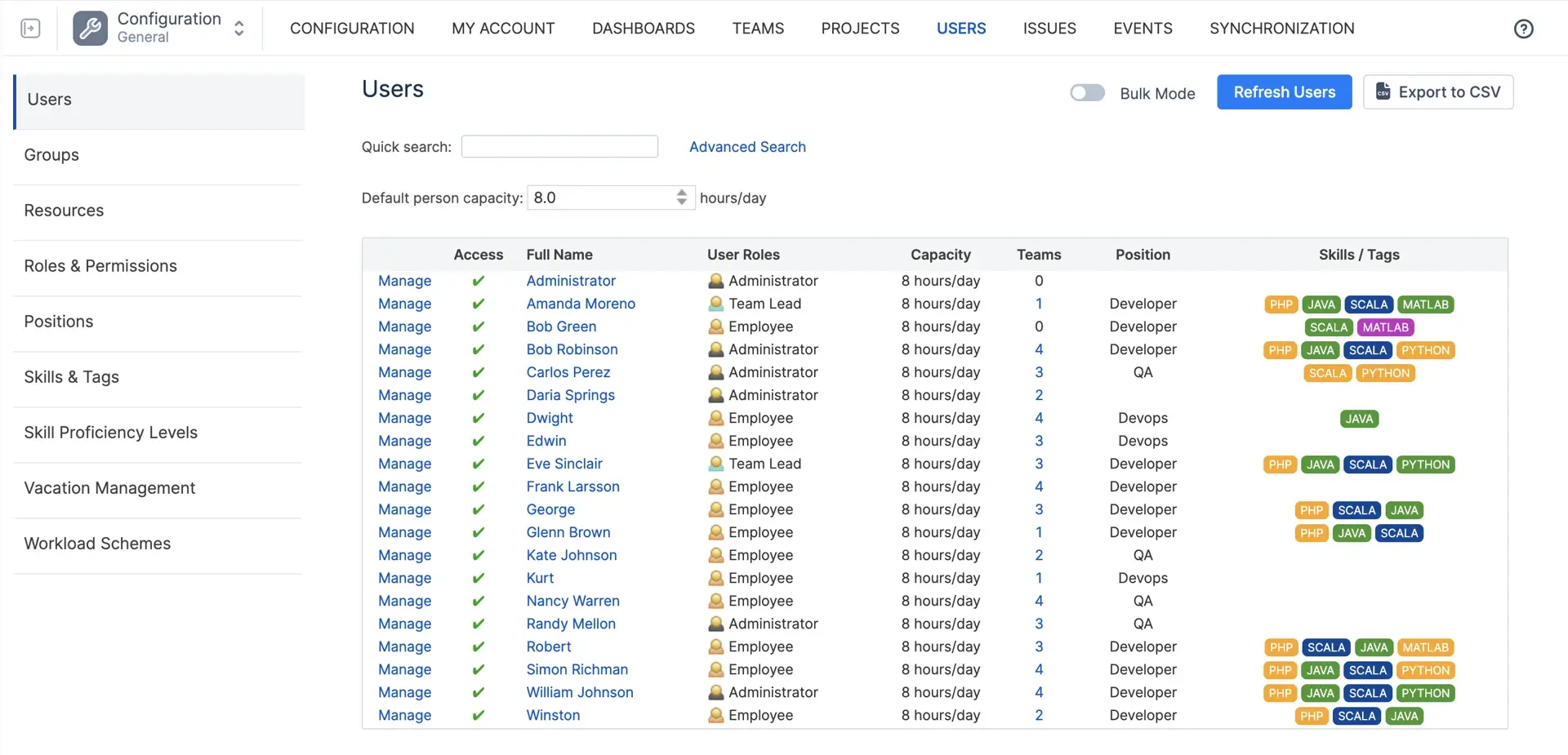
A resource is anyone you plan work for. Usually that is a person with a Jira account who shows up in ActivityTimeline automatically. It can also be someone without a Jira license (a contractor, a designer from an agency) whom you add by hand, or a non-human thing you book time on, like a test rig or a meeting room. The app treats them all the same way: each one gets a row on the timeline.
What makes a resource useful for planning is what you attach to it. A user role decides what the person can see and edit in ActivityTimeline. A position ("QA engineer", "Solution architect") describes what they do. Skills, each with a proficiency level, describe what they can do. Tags are free labels for anything else. Involvement is how many hours a day they are available, which we come back to under Capacity. None of this is required to start, but the more of it you fill in, the more the app can do for you: functional teams, skill and position availability reports, and search by skill in the Planner all depend on it.
You manage resources in ActivityTimeline Configuration → Users. If you have a lot of them, Bulk Mode edits up to 1,000 users on one page, you can remove a skill from many users at once, and Export to CSV gets the whole list into a spreadsheet. On Cloud, you can also tell the app to load users only from selected Jira groups, which keeps the list short on big instances.
What makes a resource useful for planning is what you attach to it. A user role decides what the person can see and edit in ActivityTimeline. A position ("QA engineer", "Solution architect") describes what they do. Skills, each with a proficiency level, describe what they can do. Tags are free labels for anything else. Involvement is how many hours a day they are available, which we come back to under Capacity. None of this is required to start, but the more of it you fill in, the more the app can do for you: functional teams, skill and position availability reports, and search by skill in the Planner all depend on it.
You manage resources in ActivityTimeline Configuration → Users. If you have a lot of them, Bulk Mode edits up to 1,000 users on one page, you can remove a skill from many users at once, and Export to CSV gets the whole list into a spreadsheet. On Cloud, you can also tell the app to load users only from selected Jira groups, which keeps the list short on big instances.
Gerenciamento de equipe
O conceito de equipe é bastante simples no ActivityTimeline, que é essencialmente um grupo de pessoas unidas em uma única entidade.
A classic team is one you assemble by hand: pick the people, save, done. You add and remove members whenever you like, and you can hand that job to a team lead so it stops landing on the Jira admin. This is the right choice when membership is a management decision, like a project team or a squad.
A classic team is one you assemble by hand: pick the people, save, done. You add and remove members whenever you like, and you can hand that job to a team lead so it stops landing on the Jira admin. This is the right choice when membership is a management decision, like a project team or a squad.
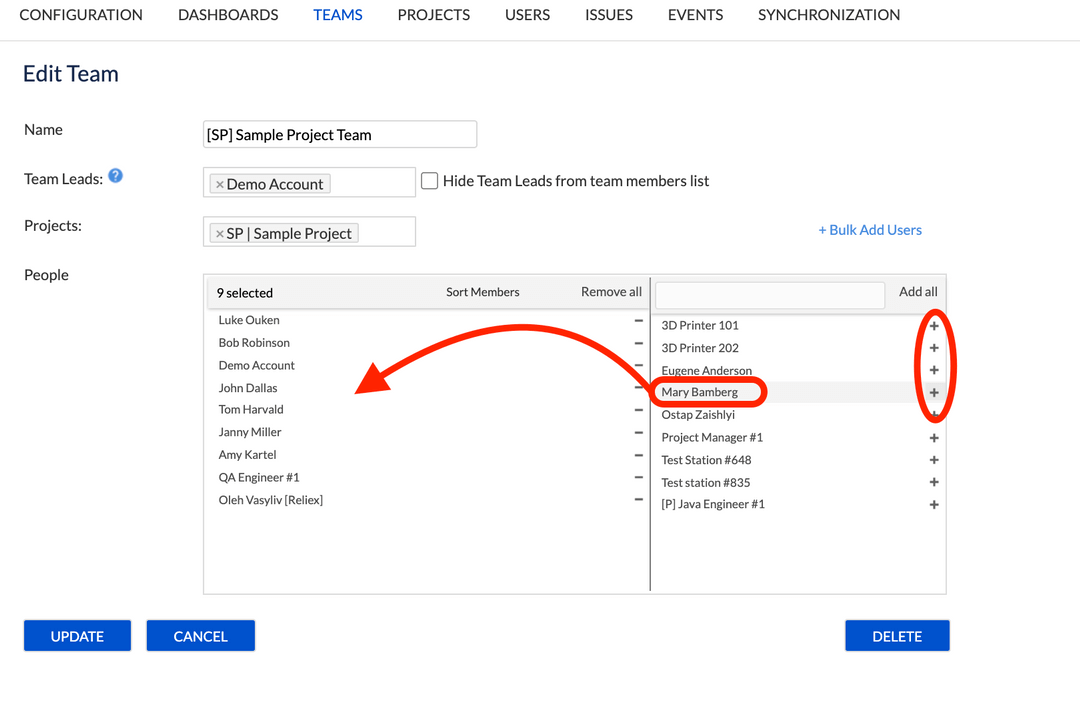
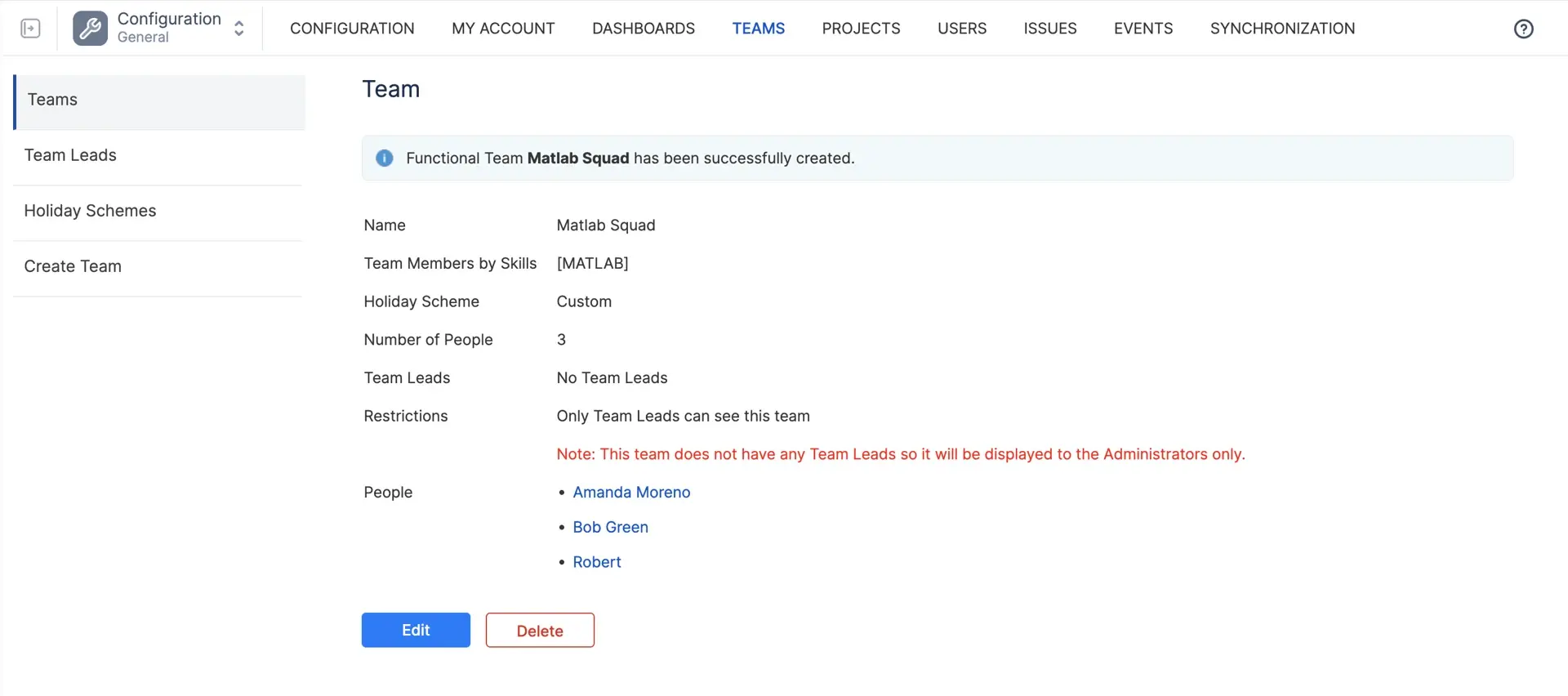
A functional team builds itself from user attributes. You choose a skill or a position, and everyone with that skill or position is in the team, now and in the future. If you hire a third Java developer next month and give them the Java skill, they appear in the "Java" team without anyone editing it. This is the right choice when membership follows what people can do rather than who they report to. The catch is that it only works if skills and positions are actually maintained, so decide who owns that before you rely on it.
Basicamente, quando você tem suas equipes configuradas e prontas, você pode planejar suas atividades, acompanhar o progresso e reportar para ver o panorama geral.
A few small things that make teams nicer to live with: you can order the members inside a team the way you want them to appear on the Planner (by role, by seniority, whatever helps the planning meeting), and a day off or a note can be created for the entire team at once instead of person by person, which is handy for company events and offsites.
A few small things that make teams nicer to live with: you can order the members inside a team the way you want them to appear on the Planner (by role, by seniority, whatever helps the planning meeting), and a day off or a note can be created for the entire team at once instead of person by person, which is handy for company events and offsites.
Cronograma pessoal
Como um software avançado de agendamento de recursos, o ActivityTimeline leva esse conceito a um nível mais alto, permitindo exibir os recursos (usuários individuais e equipes) na dimensão do tempo, além de levar em consideração a carga de trabalho e a restrição da capacidade dos recursos disponíveis.
Under the person's name you see the workload indicator, a small number per day (or per week and month when you zoom out) that says how many hours are planned against how many they have. The color tells you at a glance what to do about it: yellow and olive mean there is room for more, green means the day is full, light red and red mean too much has been planned and something has to move, blue means the person is out (day off, vacation, sick leave, holiday), and grey means nothing is planned. The thresholds behind the colors are configurable under Configuration → Workload Indicator, so if your team considers 6 planned hours a full day, you can say so.
Under the person's name you see the workload indicator, a small number per day (or per week and month when you zoom out) that says how many hours are planned against how many they have. The color tells you at a glance what to do about it: yellow and olive mean there is room for more, green means the day is full, light red and red mean too much has been planned and something has to move, blue means the person is out (day off, vacation, sick leave, holiday), and grey means nothing is planned. The thresholds behind the colors are configurable under Configuration → Workload Indicator, so if your team considers 6 planned hours a full day, you can say so.
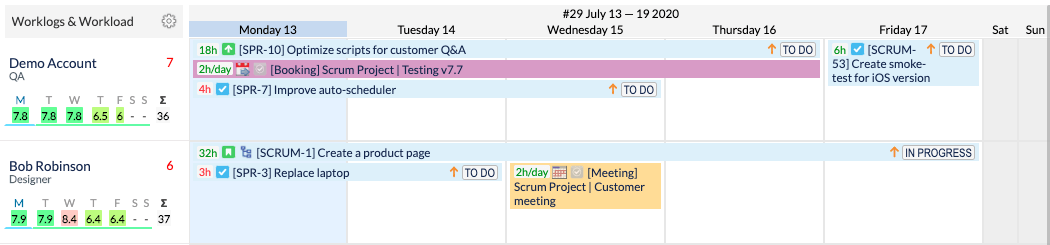
Sob o nome de cada recurso, você pode ver o indicador de carga de trabalho e exibir o número de horas alocadas para uma pessoa por um período específico. Isso depende da estimativa das tarefas associadas e dos eventos personalizados que estão programados em seu cronograma. Cores diferentes do indicador mostram o quanto uma pessoa está carregada em comparação com sua capacidade (envolvimento):

Cronograma da equipe
Essa funcionalidade amplia o conceito de cronograma e permite planejar itens de trabalho para toda a equipe em geral, sem entrar em detalhes. Isso é particularmente útil ao planejar períodos mais longos, quando o nível de certeza não é alto.
The selector on the Planner top panel switches between three views. Users shows individual timelines only. Teams shows one row per team.
The selector on the Planner top panel switches between three views. Users shows individual timelines only. Teams shows one row per team.
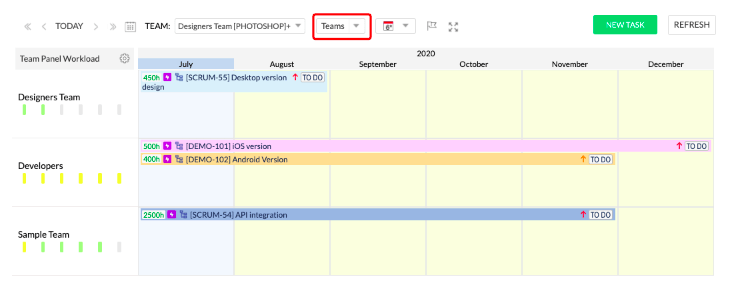
Team with Users shows the team row on top and the members underneath, so you can see the unassigned team-level work and each person's load in one screen. Team-level assignments are counted in the reports too: the Team Capacity Chart and the utilization forecasts can include or exclude team panel workload, so you can look at a team as a whole or drill down to the people.
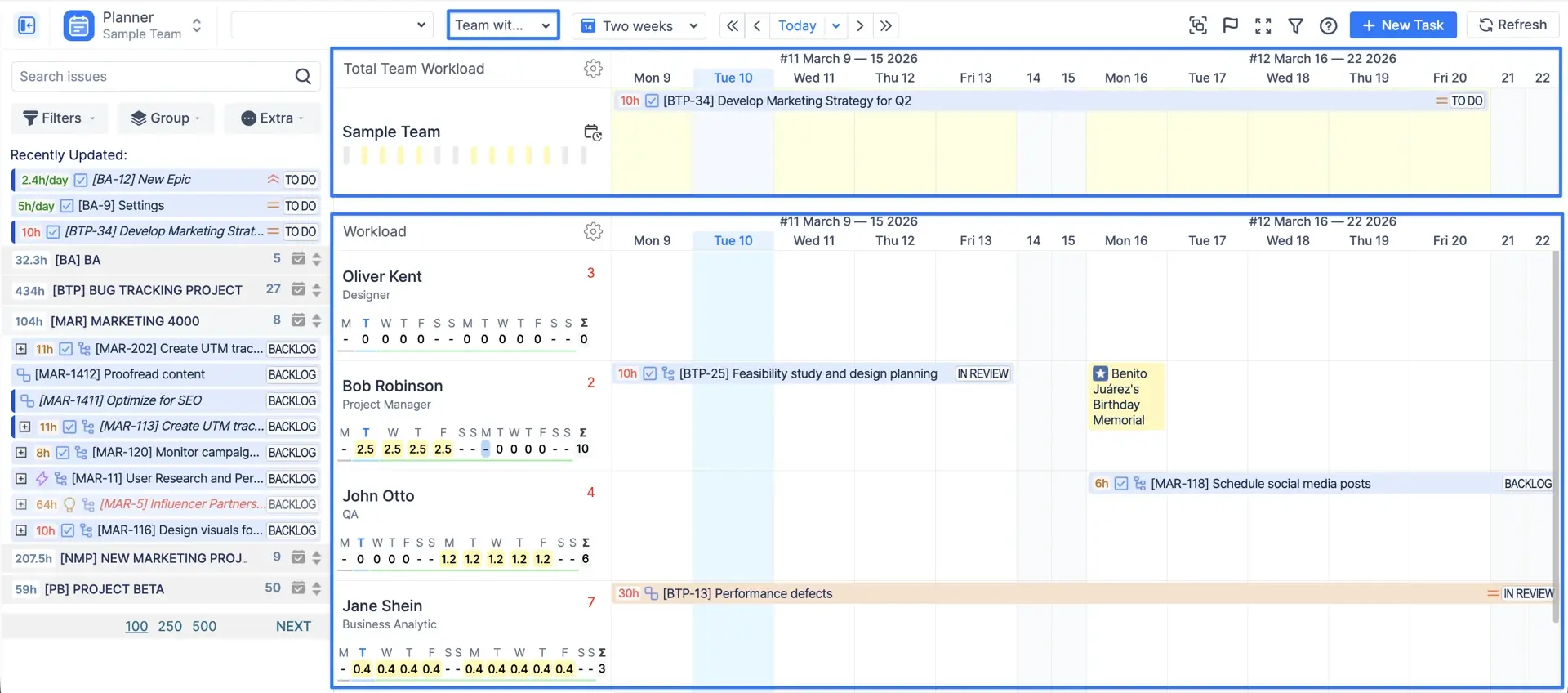
You can check the detailed guide on the Team panel in our documentation: Team panel
Tarefas do Jira
Planejamento de tarefas do Jira com facilidade. Todas as tarefas dos projetos habilitados são carregadas da sua instância do Jira para o ActivityTimeline durante a configuração inicial e podem ser planejadas por usuários com as permissões necessárias.
The panel on the left of the Planner is the backlog you plan from. One thing to know up front: by default it lists issues updated in the last 30 days, so if an old issue seems to be missing, add a filter and it will appear. Filters can include or exclude projects, sprints, assignees, statuses and custom fields, and you can search by key or text. Once you have found an issue, you drag it onto a timeline.
The panel on the left of the Planner is the backlog you plan from. One thing to know up front: by default it lists issues updated in the last 30 days, so if an old issue seems to be missing, add a filter and it will appear. Filters can include or exclude projects, sprints, assignees, statuses and custom fields, and you can search by key or text. Once you have found an issue, you drag it onto a timeline.
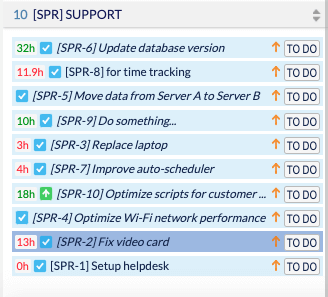
Cada problema é representado por uma barra individual, que tem um conjunto de atributos que descreve essa tarefa (ou seja, prioridade, tipo de problema, estimativa etc.). No entanto, a aparência é personalizável e pode ser ajustada de acordo com as necessidades dos usuários no Configuration → Issues. Two things that are easy to miss: an issue can be split into parts scheduled on different dates (the parts stay one Jira issue), and if an issue has placeholders attached to it, the bar shows how many, so you can see planned-but-not-committed work next to the real thing.

Eventos locais
Além dos eventos padrão do Jira, o ActivityTimeline também tem um conjunto de eventos personalizados que fornecem algumas funcionalidades adicionais e abrangem casos que geralmente não são suportados por problemas do Jira, como alocação de recursos para algumas atividades por um período específico de tempo por dia ou rastreamento de folgas e férias.
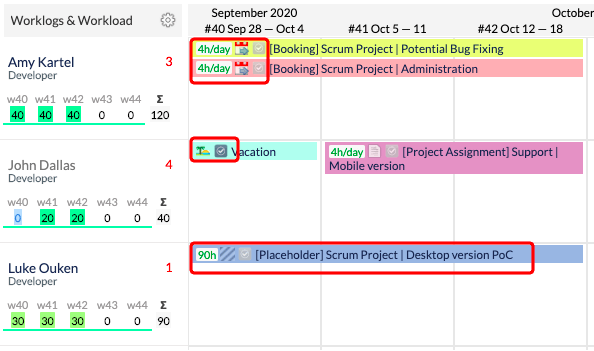
Os usuários podem criar eventos personalizados que estão disponíveis no ActivityTimeline: reserva, folga, feriado, nota, horas extras, espaço reservado, licença médica e férias. Além desses eventos, você pode criar seus eventos com base nos tipos de eventos do sistema, como reservas, um dia de folga, etc., para que você tenha ainda mais flexibilidade em termos de planejamento.
- Booking takes hours away every day it covers, which is how you reserve someone for a project before the tickets exist.
- Overtime adds hours, for the days when extra time is agreed in advance and you do not want the person to show as overloaded.
- Day Off, Vacation, Sick Leave and Holiday remove the day, or part of it: a day off can be a full day or a set number of hours, and holidays usually come from a holiday scheme so you are not entering Christmas by hand for every country.
- Note does nothing to capacity; it is a text reminder on the timeline.
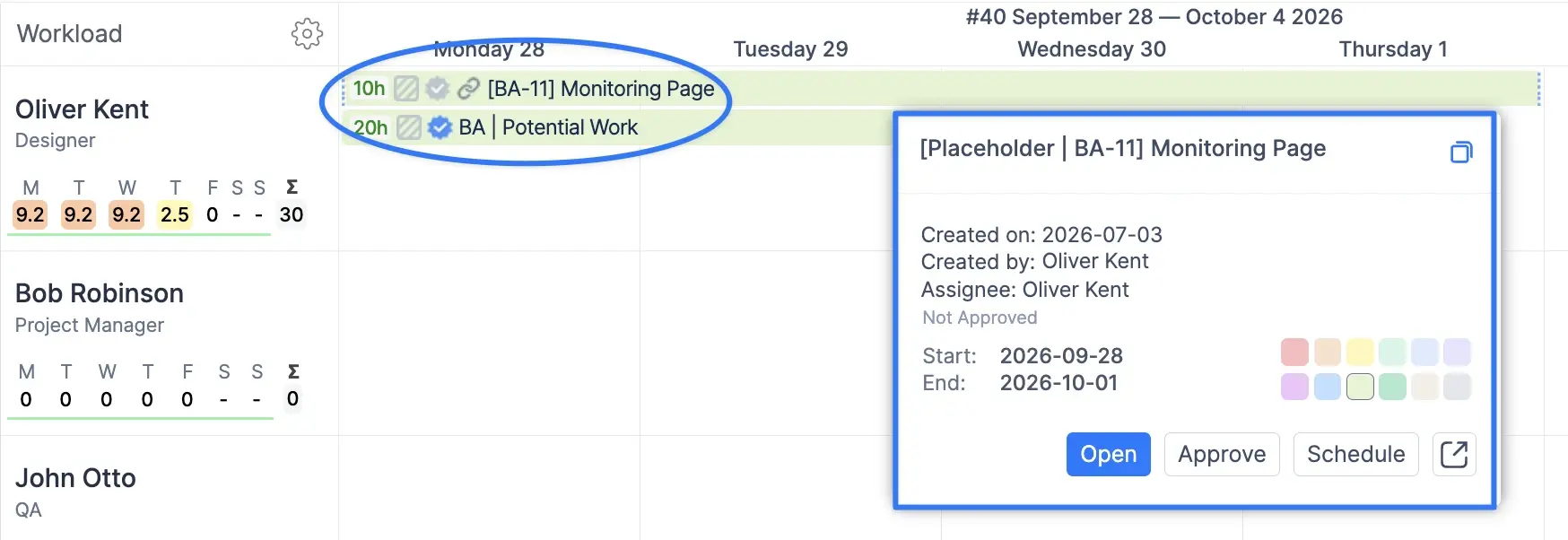
- Placeholder is the odd one out: it is a "what if" item. Use placeholders to try a plan without touching Jira, and when the plan is agreed, approve the placeholder and it turns into a real Jira issue, description included.
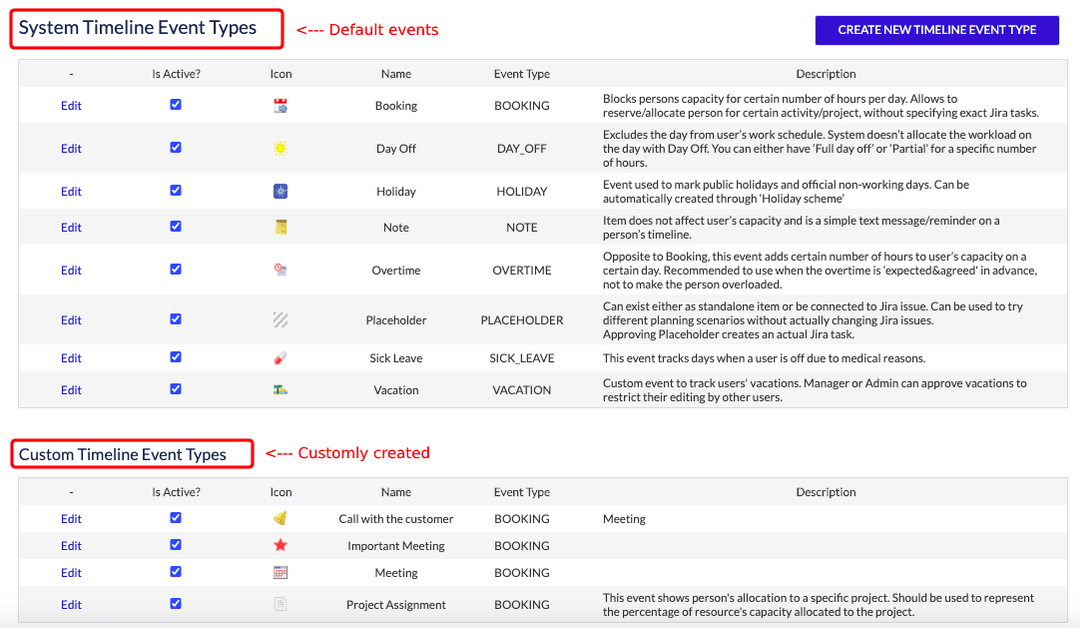
You can also make your own event types based on these eight (a "Training" event that behaves like a booking, say), and you decide per type whether it needs approval. Vacation used to require approval always; now that is a setting, and the same goes for bookings, placeholders, days off and sick leave.
If your team keeps its meetings in Google Calendar or Outlook, those can be imported and shown on the timeline as events as well, so a Tuesday full of calls looks full. Whether imported events count as logged time or are shown just for context is a setting in the timesheet configuration.
Gerenciamento da carga de trabalho
Existem diferentes interpretações do que é carga de trabalho, mas, em poucas palavras, é simplesmente a quantidade de trabalho estimada que foi atribuída a um recurso por um período de tempo especificado. O ActivityTimeline foi projetado especificamente para permitir a alocação adequada da carga de trabalho em seu recurso para garantir que todos os recursos sejam totalmente utilizados, mas não sobrecarregados.
One consequence worth stating plainly: an issue with no estimate adds nothing to the workload. It will sit on the timeline and the indicator under the person will stay yellow. If you see a full-looking timeline and a relaxed indicator, missing estimates are almost always why.
One consequence worth stating plainly: an issue with no estimate adds nothing to the workload. It will sit on the timeline and the indicator under the person will stay yellow. If you see a full-looking timeline and a relaxed indicator, missing estimates are almost always why.

Você pode aprender mais sobre o indicador de carga de trabalho em nossa documentação:
You can learn more about the workload indicator in our documentation: Indicador de carga de trabalho
You can learn more about the workload indicator in our documentation: Indicador de carga de trabalho
Gerenciamento de capacidade
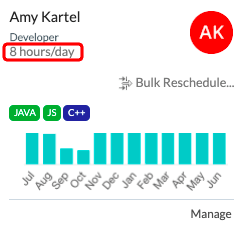
O planejamento da capacidade de recursos no Jira se torna fácil com o ActivityTimeline. Para saber se a pessoa está sobrecarregada, subcarregada ou se a quantidade de trabalho é perfeita, você precisa definir a capacidade do recurso ou, como o chamamos, - involvement: the number of hours a day a person is available for planned work. The default is set once for the whole organization (8 hours is typical), and then you override it wherever reality differs: a part-timer at 4 hours, a team lead at 6 because two hours a day go to meetings, a specific week at 0 because of a conference. Involvement can be set per person and per day.
Ao calcular a carga de trabalho do recurso, o sistema comparará a quantidade de trabalho alocada para a pessoa em um período e determinará se o recurso está sobrecarregado, subcarregado ou se ele tem uma carga de trabalho nominal.
The comparison of workload against capacity is what colors the indicator: below capacity is yellow or olive, at capacity is green, above it is light red or red. Vacation balances have their own cycle, and you can set when that cycle starts, globally or per person, so it lines up with your HR calendar rather than the January default.
The comparison of workload against capacity is what colors the indicator: below capacity is yellow or olive, at capacity is green, above it is light red or red. Vacation balances have their own cycle, and you can set when that cycle starts, globally or per person, so it lines up with your HR calendar rather than the January default.
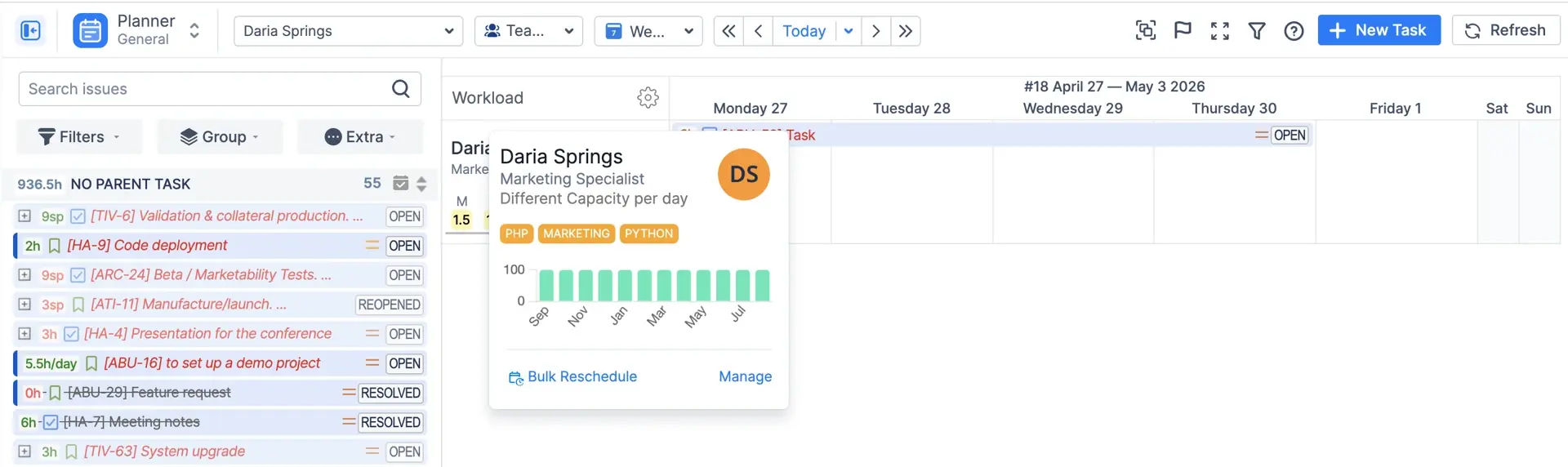
Você pode gerenciar o envolvimento individual de cada recurso em seu perfil:
Rastreamento de tempo do Jira (registros de trabalho)
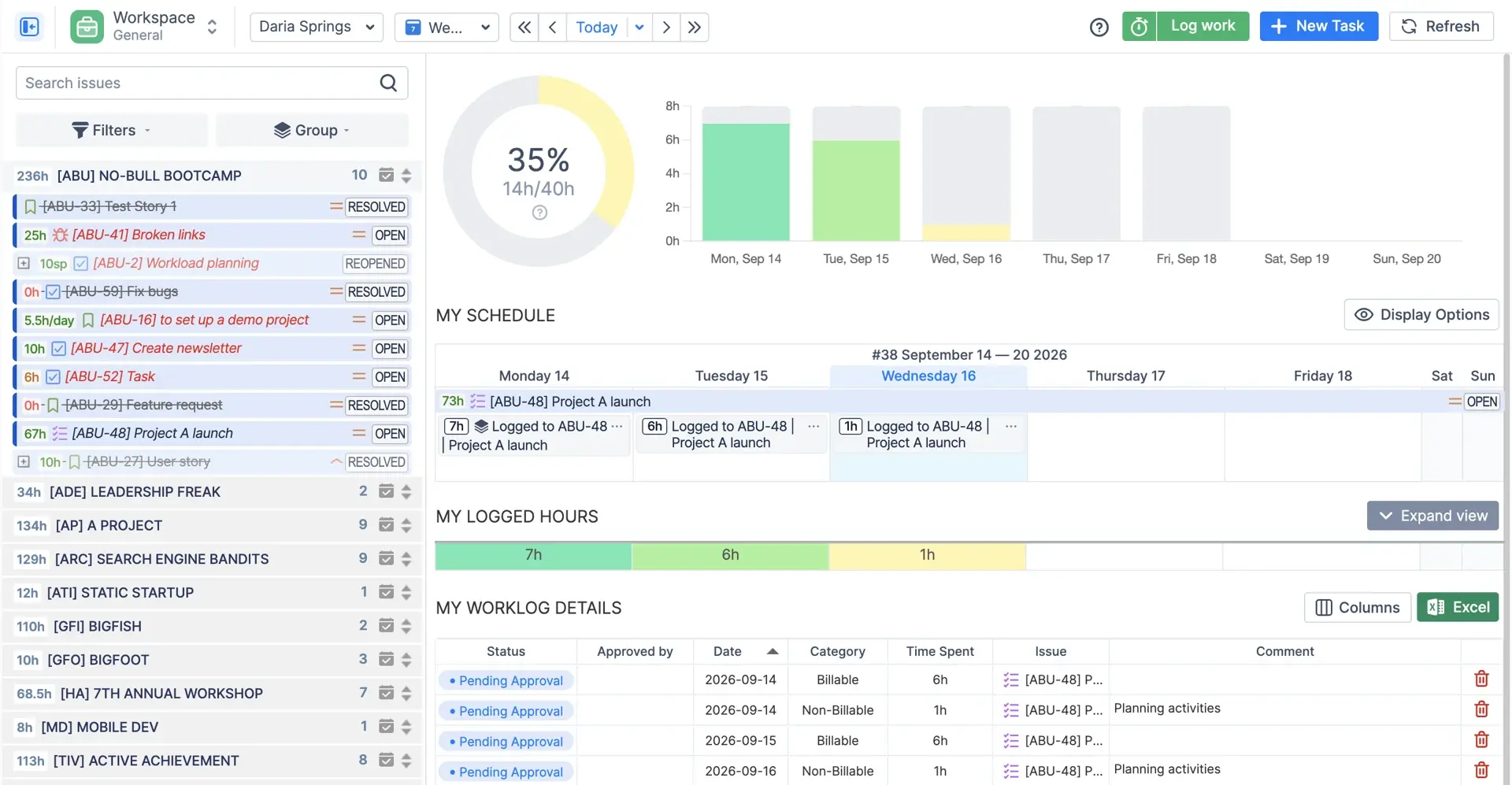
Os registros de trabalho são entradas de tempo que os usuários enviaram para as tarefas do Jira enquanto trabalhavam nelas. O ActivityTimeline os sincroniza a partir do Jira e permite registrar o tempo diretamente por meio de sua interface de usuário.
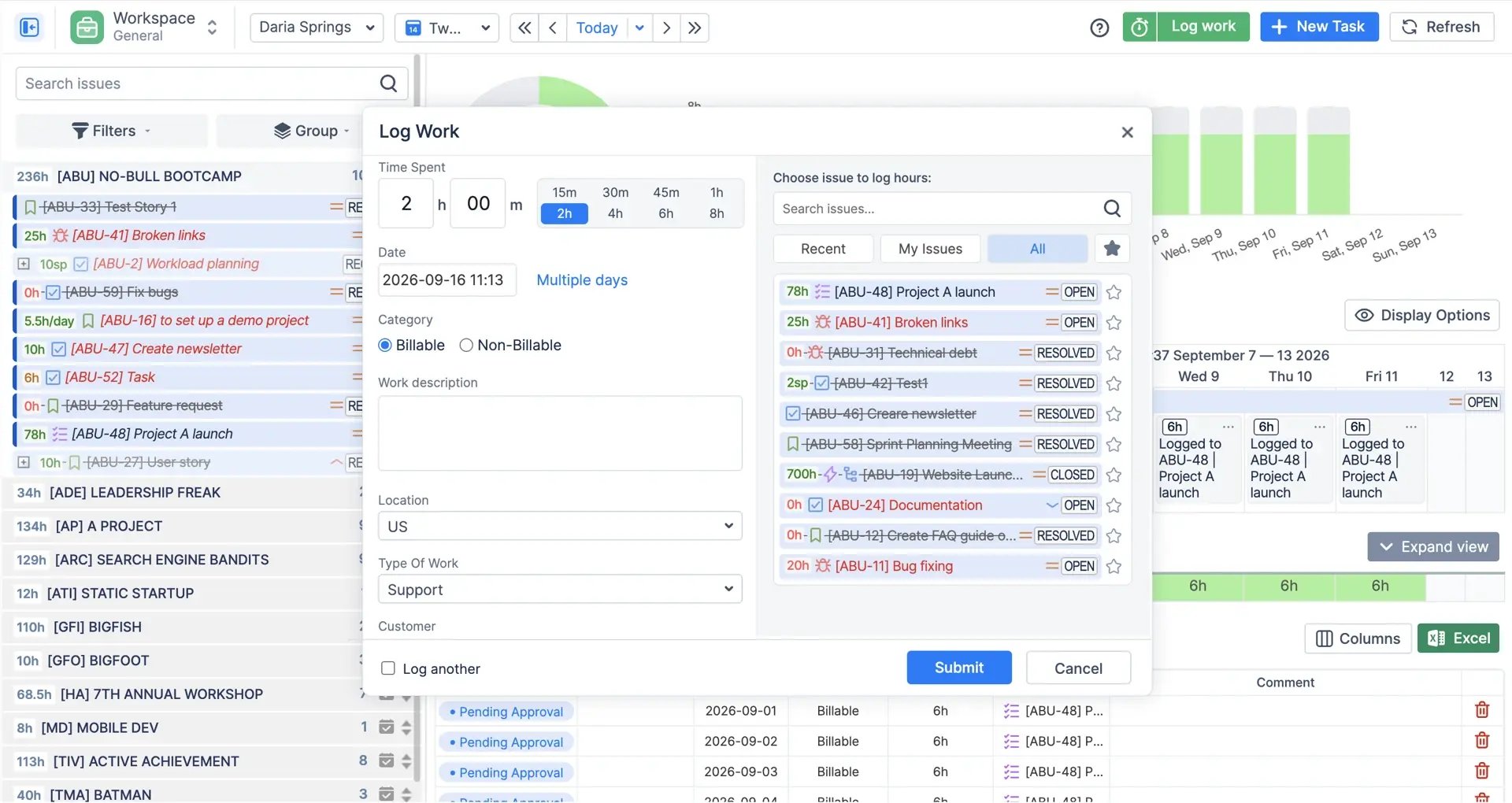
Worklogs can carry more than a number: a category (billable or not, say) and custom attributes your finance team asks for. Admins can limit how far back someone may log, with options from a few days to 75, which matters if you close books monthly.
Where worklogs show up: the Timesheets module is the main place, with filters that separate Jira worklogs from bookings and calendar events. On the Planner, the default indicator mode called Worklogs & Workload shows logged time for the past and planned time for the future in the same row, which is the fastest way to see whether the plan matched reality. That comparison, planned against actual, is what makes estimates get better over time: if a type of task is always logged at twice its estimate, you will see it within a few sprints.
Where worklogs show up: the Timesheets module is the main place, with filters that separate Jira worklogs from bookings and calendar events. On the Planner, the default indicator mode called Worklogs & Workload shows logged time for the past and planned time for the future in the same row, which is the fastest way to see whether the plan matched reality. That comparison, planned against actual, is what makes estimates get better over time: if a type of task is always logged at twice its estimate, you will see it within a few sprints.
Se você tiver alguma dúvida adicional relacionada à seção a seguir, não hesite em entrar em contato com nossa equipe em:
How it all fits together
Everything above reduces to three numbers per person per day. Capacity is how much time they have. Workload is how much you have planned for them. Worklogs are how much they actually spent. Workload against capacity tells you whether the plan is realistic. Worklogs against workload tells you whether your estimates were.
Resources and teams are who those numbers belong to, personal and team timelines are where you see them, and Jira tasks and custom events are what produces them. That is the whole model. Most teams never need more than this, and the teams that do (finance modules, forecasts by skill, REST API) find it two or three clicks further in.
If something on this page does not match what you see in your instance, tell us at reliex.com/support. This page gets updated when the app does, and a fair share of those updates started as a support ticket.
Resources and teams are who those numbers belong to, personal and team timelines are where you see them, and Jira tasks and custom events are what produces them. That is the whole model. Most teams never need more than this, and the teams that do (finance modules, forecasts by skill, REST API) find it two or three clicks further in.
If something on this page does not match what you see in your instance, tell us at reliex.com/support. This page gets updated when the app does, and a fair share of those updates started as a support ticket.

Try it with your own Jira. The trial is 30 days, no credit card, and the setup wizard walks you through the same concepts in the same order as this page.