Holiday calendars in Jira serve as a vital tool for project managers and teams. They help ensure that project planning considers holidays, team members leave, and other non-working days. By creating a Jira Holiday Calendar, you can maintain project timelines, allocate resources efficiently, and minimize potential disruptions caused by team members' absence.
This article offers practical insights into Jira Leave Management, specifically focusing on how to effectively handle your team's vacation and holiday schedules within Jira timelines. The utilization of the ActivityTimeline add-on for Jira simplifies the process of tracking your team members' availability for new assignments, identifying open slots for fresh projects, and recognizing periods when they will be absent from the office for extended durations.
Does Jira have a built-in holiday calendar?
No. Jira has no concept of a non-working day. You can set hours per day and days per week in the time tracking settings, which tells Jira how to convert "3d" into hours, and that is as close as it gets. A public holiday, a person's vacation, a half day at the dentist: none of them exist as far as Jira is concerned, which is why a sprint plan will happily assume a full team on 25 December.
Three workarounds, with their real costs.
- A holidays project, where each holiday is an issue with a due date, is free and visible on a board. It does nothing to anyone's capacity, so the plan still assumes everyone is working, and someone has to create next year's issues every December.
- A synced calendar, through a Jira calendar app or a Google Calendar integration, gets holidays in front of people. Same limitation: visibility without arithmetic.
- A resource planning app holds holidays as non-working events, so they come out of capacity automatically and the plan changes by itself. That is the version that actually prevents the mistake, and it is what the rest of this guide covers.
How to Manage Vacation Days and Holidays in Jira?
Jira, by default, doesn't have built-in features specifically designed for tracking holidays, vacations, sick leaves, or other types of non-working days. However, you can use some workarounds or third-party apps to achieve this.
Resource Management with ActivityTimeline
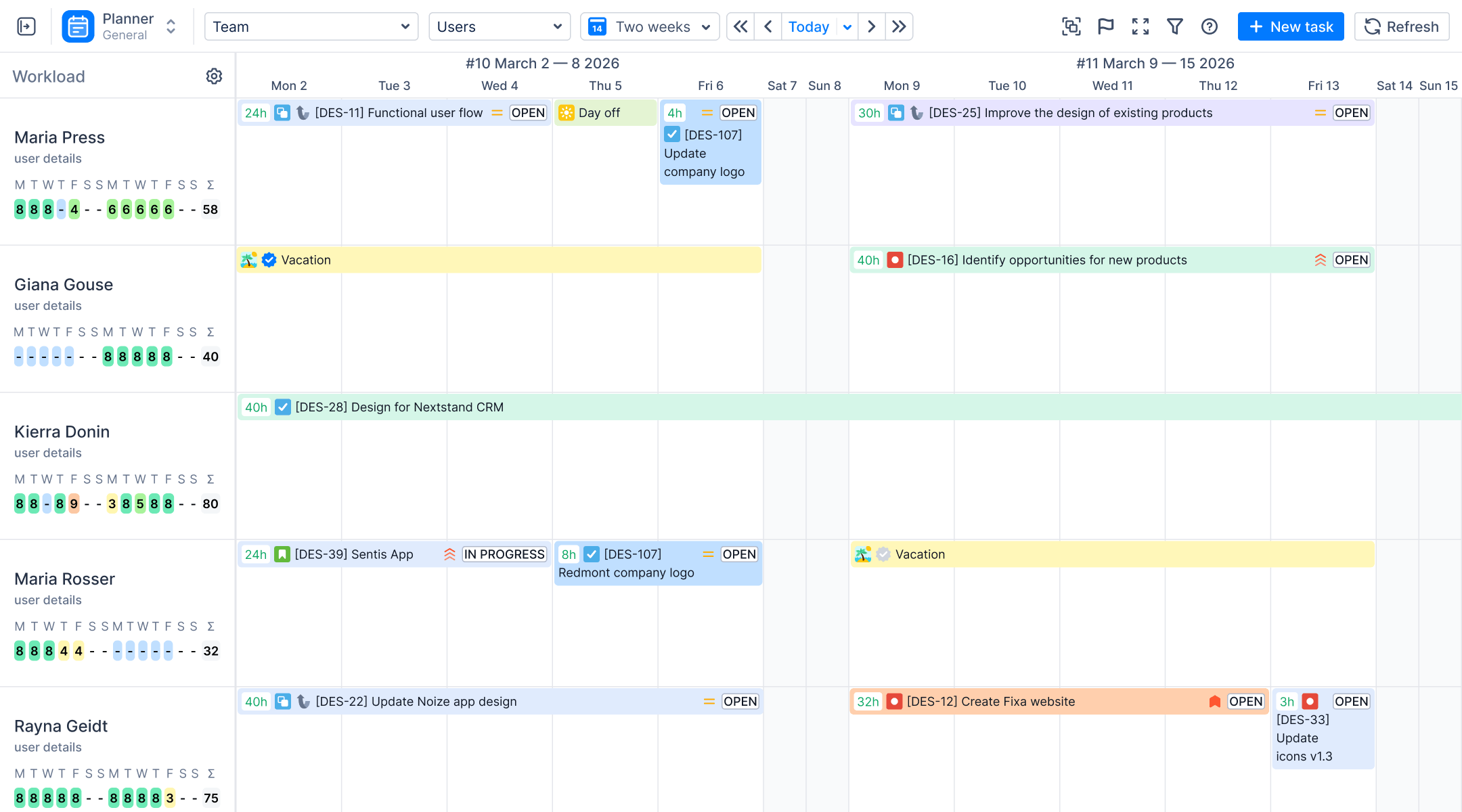
ActivityTimeline is a resource planning and tracking tool for Jira, that helps to manage teams, projects, and tasks in the same place. It provides a comprehensive Planning Dashboard that contains user and team timelines. You can schedule Jira issues or create new tasks directly from these timelines and always understand who is doing what and when it will be done with ease:

Track Team Members' Vacations
What is more important, this app offers a special feature named - Leave Management. Leave Management involves overseeing and maintaining a record of employees' leave-related information within the organization's Jira vacation calendar. Managing employee leave process manually can be quite time-consuming, requiring the manual tracking of leave requests, approvals, and related data. Additionally, the data may need to be manually entered into a system for tracking and reporting purposes.
By adopting an automated Leave Management solution, you can significantly streamline the process and reduce the time invested in it. Jira lacks this feature, but there are tools, like ActivityTimeline that can help with this problem.

Manage Sick Leave and Vacation Requests
How can ActivityTimeline help you with leave management? Here are some key points:
- Monitor Employee Absences: ActivityTimeline offers a comprehensive solution for overseeing employee vacations and tracking their availability. This tool provides real-time insights into when your team members will be present at work and when they will be on leave.
- Manage Full or Partial Day-Offs with Ease: Effortlessly create custom full-day or partial-day leave requests by simply clicking on the calendar within ActivityTimeline.
- Public Holiday Integration: ActivityTimeline allows you to establish a public holiday calendar that can be seamlessly integrated into your team's schedule. Furthermore, you have the option to add events, such as sick leaves or holidays, for all team members at once and configure recurring events for repetitive activities.
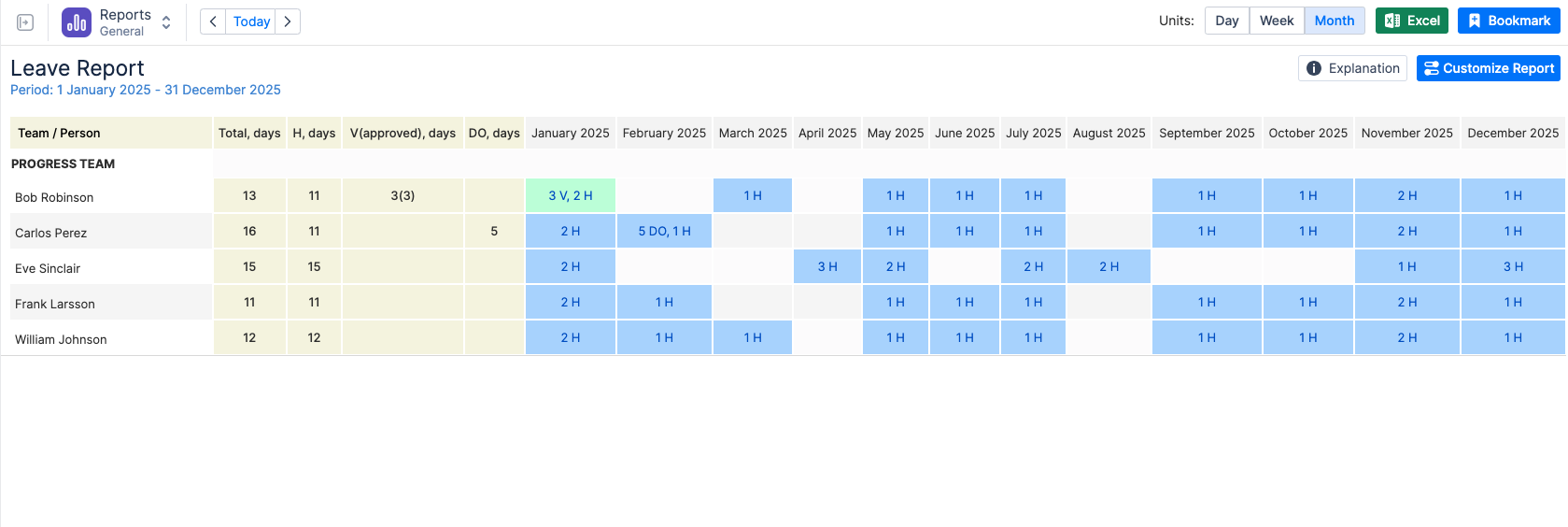
- Leave Reports: The app also offers Leave Reports that help a vacation Manager track public holidays, vacation requests, leave requests, and vacation days.
The app provides internal events to track and manage non-working days. There are default ones such as holidays, vacations, sick leaves, and days off:

You can easily manage vacations or sick leave on the timelines and see when the team member will not be available for work.Each user has a special workload indicator, which shows the number of working hours per day. When you create a vacation or other type of event, the indicator will be updated, to show non-working hours:

You can create a holiday or any other event for the entire team with a few clicks.

There are also other interesting custom event options like:
- Bookings - This event type blocks persons' capacity for a certain number of hours per day. Allows to allocate a person for a certain activity, without specifying exact Jira tasks.
- Placeholders - Can exist either as a standalone item or be connected to the Jira issue. Can be used to try different planning scenarios without actually changing Jira issues. Approving the Placeholder creates an actual Jira task.

- Over time - Opposite to Booking, this event adds a certain number of hours to the user’s capacity on a certain day.
- Note - The item does not affect the user’s capacity and is a simple text message/reminder on a person’s timeline.
Users can even create their events within the app, which is very useful, as very often companies have different activities connected with the work process, and these activities are not available in Jira (like business trips, meetings, team buildings, etc.):

How to create a holiday scheme in ActivityTimeline
A holiday scheme is a predefined set of holidays applied to a whole team or group, instead of creating each holiday one at a time for each person.
- Go to Configuration, then Teams, then Holidays Schemes. Any existing or imported schemes are listed here.
- Click Create new scheme.
- Choose the teams or Jira groups the scheme should apply to. Since v11.2.0 you can also assign a scheme directly to individual users, without a team or group.
- Name the scheme. If you have offices in more than one country, name it after the location rather than the year, because one scheme can hold several years of holidays.
- Either click the days you want to mark as holidays, or choose a country and let the system fill in that country's official public holidays. The populated list is editable, so you can adjust it to your company's approved list.
- Give each holiday a name. If you leave the name blank, only the date is saved.
- Click Create.
To add more years to the same scheme, use the Previous and Next buttons while editing it. Holidays for 2026 through 2029 can live in one scheme.
If your company spans countries or regions, the thing to get right is the grouping. Create a Jira group or a team per location, a "USA-office" group for example, and apply a holiday scheme to it. Trying to run one scheme for everyone is the mistake people make first.
If you already run Tempo Timesheets on this Jira instance, you can import its holiday schemes rather than rebuilding them: Configuration, Teams, Holidays Schemes, Import Holiday Schemes. Imported schemes are marked [TEMPO]. You need both Jira admin and Tempo admin permissions.
To edit or delete a scheme later, use the Edit and Delete links on the Holidays Schemes page, or open Show and use the buttons inside.

How vacation requests and approvals work
A vacation can be created by the employee on their own timeline, or by a manager on their behalf. At that point it is pending and does not touch the person's remaining allowance. A manager then approves it, leaves it unapproved, or deletes it. Only approved vacations count against the yearly limit, which means the remaining balance is always based on confirmed leave rather than intentions. Unapproved and approved vacations look different on the timeline, with approved ones shown in brackets.
Allowances are set in Configuration, Users, Vacation Management. You can set one number for the whole organisation under "Number of Allowed Vacation Days per Year", or override it per person via Configuration, Users, Manage, "Approved Vacation Days Limit", which is what you need when entitlement depends on seniority or country. Bulk Mode on the User Management page updates many people at once.
The vacation year can start on a fixed date for everyone, 1 January by default, or follow each person's own start date. Turn on "Use User Start Date as Vacation Year Start Date" on the Vacation Management page and each person's cycle runs from their Start Working Date. Anyone without a start date falls back to the global cycle.
Sick leave, days off and partial days
Sick Leave, Day Off, Vacation and Holiday are four separate event types, and the distinction matters because they report differently even though they all reduce capacity. Day Off and Vacation can be full day or partial, meaning a specific number of hours, which is how you record the two hours someone spent at the dentist without pretending they lost the day. Administrators can rename these types or create new ones based on them under Configuration, Events.
What time off does to the plan
This is the part a holidays project cannot do. When a non-working event is created, the workload indicator for that day shows a dash and the system recalculates the workload, moving planned work to the days that are still available. If Monday becomes a day off and eight hours of work were scheduled there, those hours move to Tuesday, and Tuesday's indicator shows it is now booked for eight hours. So the plan corrects itself rather than quietly becoming wrong.
You are welcome to check out our video explaining the process of Holiday Schemes creation for better understanding:
Tracking who has taken what
Two reports live under Reports, Other Reports. The Vacations Report shows, per person, the allowed vacation days for the year, how many days have been requested, how many are approved, and a Remaining Vacation Days column. Only approved vacations are deducted from the remaining balance. The one-year period runs from each person's Start Working Date, which an administrator sets in Configuration, Users, Edit Person; without one, the current calendar year is used.
The Leave Report covers events more broadly. And the Timeline Report exports everything visible on people's timelines, issues, events, time off, workload and worklogs, into Excel, which is the one to use when someone wants a full snapshot rather than an answer.
Conclusion
In conclusion, Jira vacation calendar is an indispensable tool for effective project planning and resource management. By integrating the right tool and following the simple steps outlined in this guide, you can seamlessly integrate holidays and leave into your project schedules, ensuring that your projects stay on track even when team members are away. This proactive approach not only minimizes disruptions but also enhances your project management capabilities, contributing to the successful and timely delivery of your projects.