Key takeaways
- Jira Cloud has a calendar view that shows a project's issues by due date, with sprints and releases; it doesn't show people, their hours or their time off.
- A team calendar answers a different question: who is working on what, on which days, and who is away.
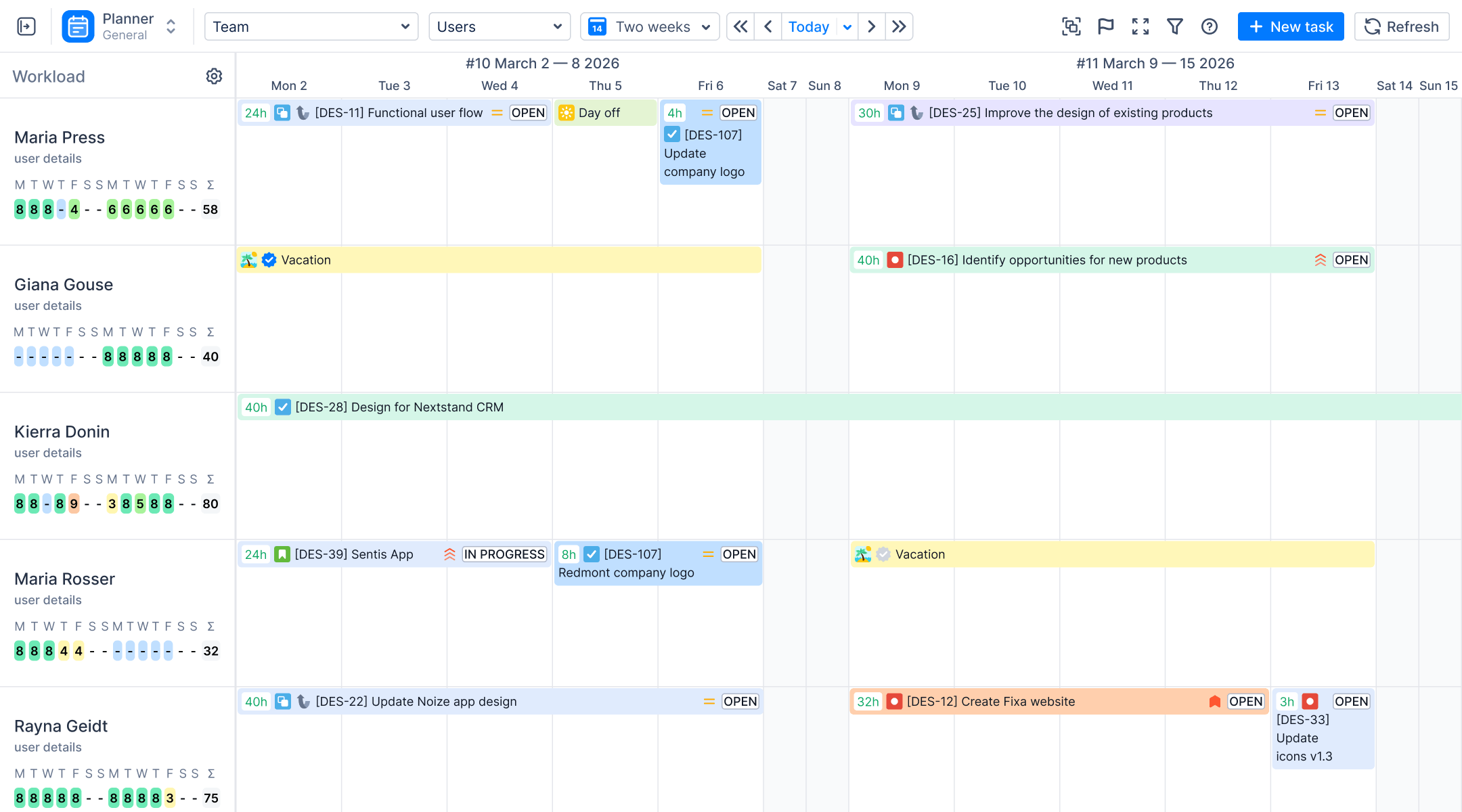
- In ActivityTimeline, the Planner shows every team member as a row with their Jira issues, vacations, holidays and meetings, across all projects.
- Workload colors show each day as free, full or overloaded, and blue marks days out of office.
- You can export the team calendar to Google Calendar, Outlook or Apple Calendar, and import meetings back. Try ActivityTimeline free for 30 days.
Someone asks "can we start the migration on Monday?" and nobody knows, because Anna's vacation is in a spreadsheet, the release date is in Jira and the client workshop is in Outlook. Jira has a calendar, but it's a calendar of issues. It doesn't show that half the team is away next week.
Here's the short answer: Jira's built-in calendar view shows one project's issues by due date. For a team calendar with people, workload and time off, you need an app. Below is what Jira gives you out of the box, and how to set up a full team calendar in ActivityTimeline in about ten minutes.
Jira Calendar View
Jira Cloud has a calendar view for each project, and it's a calendar of work, not of people. It places issues on their due date (or across start and due date), and shows sprints and releases on the same grid.

To open it, go to your project and select Calendar in the project's views. You can drag an issue to another day to change its due date, create an issue on a date, and filter by assignee, type or status.

What it doesn't show: how many hours each person has planned, who is on vacation or sick leave, public holidays, or meetings. And it shows one project at a time, so a person working across three projects appears in three calendars.

Team Calendars with ActivityTimeline
ActivityTimeline is a Jira app for Cloud and Data Center. It reads your Jira issues and lays them out per person, on a timeline that works as the team calendar. Setting one up takes four steps:
- Create the team. As an administrator or manager, go to Configuration → Teams. Add people by hand, group them by skill or position, or import a Jira team or Jira group.
- Open the Planner and pick the team from the users and teams dropdown.
- Choose the view. Users shows one row per person. Team with Users adds a team row on top for work that isn't assigned to anyone yet. Teams shows whole teams, for planning months or quarters ahead.
- Choose the period: a week, two weeks, a month, a quarter, half a year or a year.

Jira issues from every enabled project show on the days they're planned. Drag an issue from the left panel onto someone's row to schedule it, or drag it between people to reassign it; the change goes back to Jira.
Under each name, the workload indicator colors every day. Yellow and olive mean there's room, green means fully planned, light red and red mean overloaded, blue means out of office. Switch it to availability mode and you see hours left instead, which is the number you need when someone asks "can Anna take one more?".
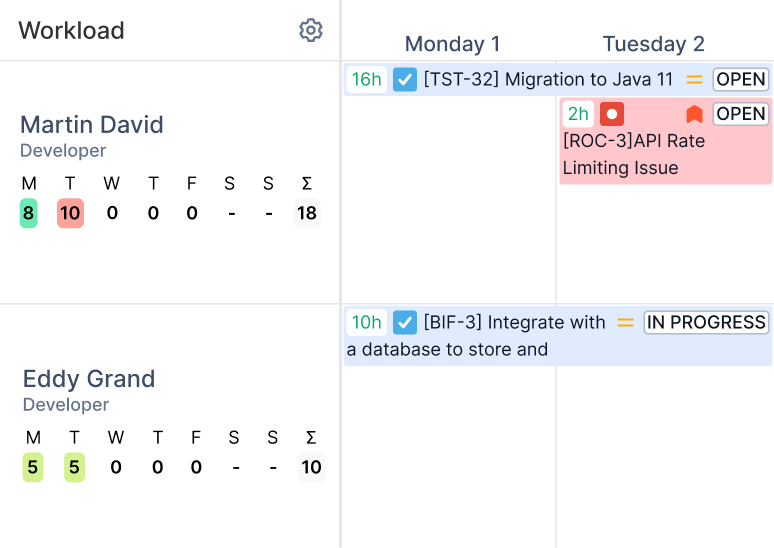
It's also possible to switch these indicators to availability mode, or show the number of tasks per day:

ActivityTimeline introduces a Team Panel alongside the user timeline feature, empowering teams with strategic planning capabilities and improved oversight. This specialized team calendar streamlines resource allocation and scheduling, allowing users to devise long-term plans spanning months or quarters.
The Team mode provides a clear depiction of workloads across teams, greatly simplifying comprehensive planning for individual teams or the entire organization.

How to add holidays, time off and meetings to the team calendar
Jira has no place for a vacation or a public holiday. In ActivityTimeline these are custom events: they live in the app, never create Jira issues, and change how many hours a person has.
To add one, click a cell on someone's row and choose the event type in the Create New Item dialog. There are eight built-in types:

Two shortcuts save most of the clicking. Public holidays come from a holiday scheme per country, so you don't enter them by hand. And to copy an event to another person or day, drag it while holding Ctrl (Windows) or Cmd (Mac). A booking can be created for the whole team at once with Create for everyone in this Team.
Above the rows, the milestones panel (the flag icon) shows releases, sprints of the boards you choose, and your own milestones such as a demo or a deadline
Milestone Panel helps to track important events and tasks:

Can you sync the Jira team calendar with Google Calendar or Outlook?
Yes, both ways.
Export. Each person can copy their calendar link from My Account → Calendar Integration and subscribe to it in Google Calendar (Other calendars → From URL), Outlook (Add calendar → From the Internet) or Apple Calendar. A manager can export a whole team from Configuration → Teams → Export to Calendar. Google refreshes subscribed calendars about every 8 hours, so changes don't appear instantly.
Import. Meetings from Google Calendar (Cloud only) and Outlook show on the person's row, so a Tuesday full of calls looks full. By default imported meetings also count as time spent; you can turn that off in Configuration → Timesheet Settings.
Shared Outlook calendars aren't supported. Step-by-step guides: Jira and Outlook.
What a team calendar won't fix
A calendar is only as good as the estimates behind it. If issues have no estimates, ActivityTimeline can place them on the right days, but the workload colors can't tell you whether those days are full. Teams that estimate in story points only will see issues on the calendar without hours. So the first week, the useful habit is small: estimate what's scheduled for the next two weeks, and the colors start telling the truth.
A team calendar doesn't plan the work for you. It shows you where the plan doesn't fit.