

Trendformer is a Ukrainian company with IT and Creative divisions based in Kyiv, bringing together a team of more than 100 Jira users working across multiple countries. The company produces and sells children’s toys, including air-drying modeling clay and magnetic construction cubes, while also investing in research and development for new product ideas such as board games and other creative products.
A distinctive part of Trendformer’s business is that its products are supported by mobile applications. In addition to its manufacturing operations, the company includes a wide range of teams working in Jira, including IT, sales, marketing, administration, design, sculpting, animation, and production-related functions.
To better understand how Trendformer approaches planning and coordination, we spoke with Ivan S., Atlassian Administrator, Traffic Manager, and Scrum Master. His role is to connect different departments within one system, ensure smooth communication, and support planning across teams working with Scrum, Kanban, and more traditional approaches.
Trendformer started using ActivityTimeline when Ivan joined the company. Having already worked with the app in previous organizations, he brought hands-on experience and introduced it as a proven solution for resource planning. Over time, ActivityTimeline became his go-to tool, which he has implemented in multiple companies to solve similar challenges around visibility, coordination, and workload management.
The Challenge
As the company grew, coordinating work across teams became increasingly complex. Many specialists, especially designers, were shared across multiple departments. They were involved in packaging, localization, product development, animation, and other cross-functional initiatives at the same time.
This created constant tension around prioritization, deadlines, and expectations from different teams.
“It was very important — and very difficult — to find a solution that would allow resource planning for shared resources.”Ivan S., Atlassian Administrator, Traffic Manager, and Scrum Master at Trendformer
Managers needed a way to understand who was working on what, how busy people were, and whether new or urgent tasks could realistically be added to the plan. Without this visibility, planning decisions were often reactive, and teams had to rely on constant communication to clarify availability.
Jira alone did not provide the level of planning visibility required for this type of coordination.
“Jira doesn’t have that. In short, after researching Jira, I realized that this functionality simply does not exist there.”
Ivan S., Atlassian Administrator, Traffic Manager, and Scrum Master at Trendformer
The company needed more than task tracking. They needed a centralized planning layer that would allow them to:
- see workloads across teams
- plan work ahead in a calendar view
- manage shared resources effectively
- account for vacations and non-working time
- reserve time for expected or upcoming work
The Solution
ActivityTimeline became the solution that filled this gap.
With Ivan’s prior experience using the app, the decision was straightforward. He introduced ActivityTimeline as a tool that could provide immediate value without requiring major process changes.
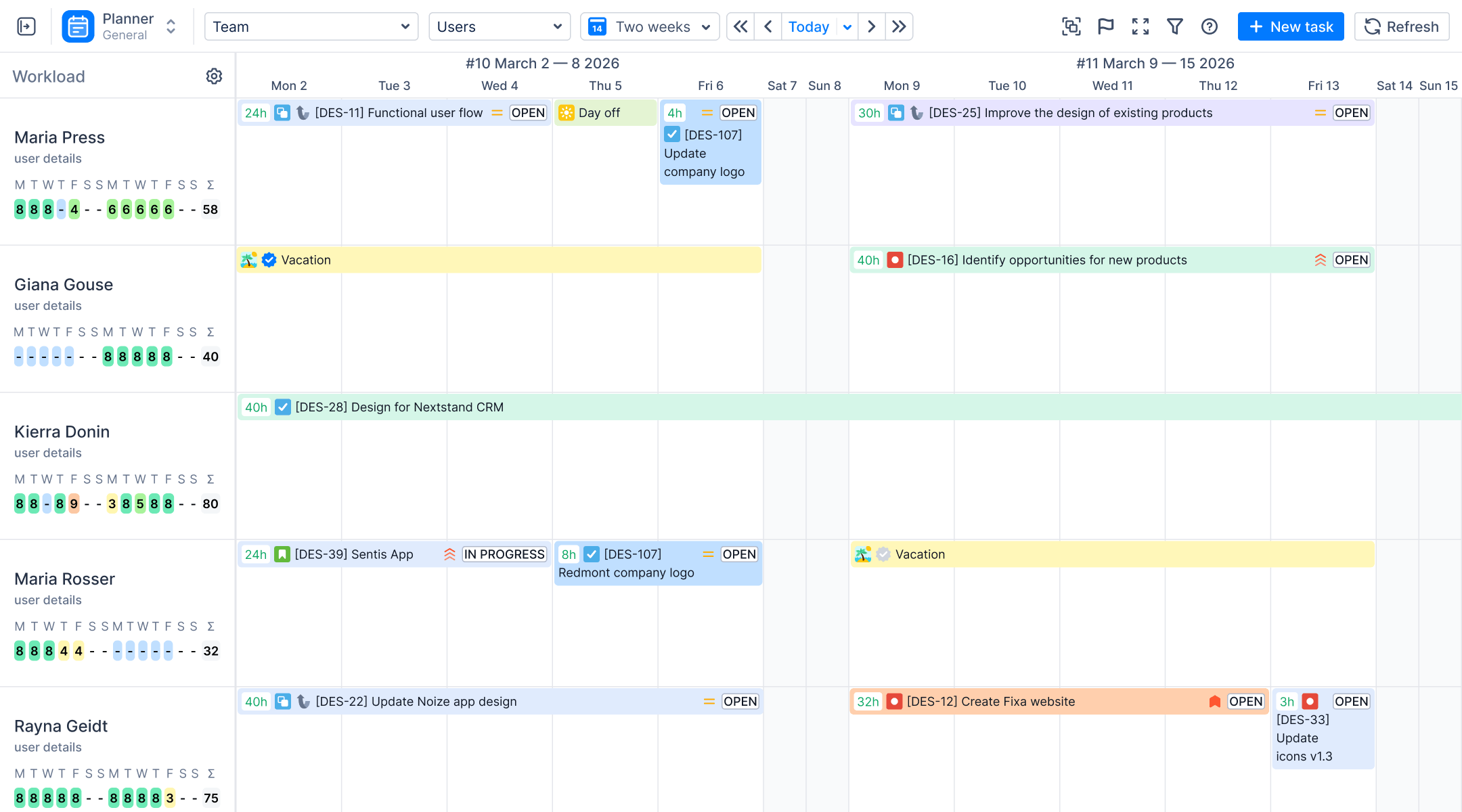
The planner quickly became the central place for managing and coordinating work across teams. In practice, all managers work directly in the planner. The traffic manager and department heads create and adjust plans on a weekly basis, while some teams maintain longer-term plans for standard tasks that can extend up to six months ahead and are continuously refined.
“So all managers work only with the planner. We have a traffic manager — that’s me — and department heads who every week create the plan for the following week and adjust it. For some teams, there is a plan for half a year ahead for standard tasks. It is just adjusted every week. Managers simply go in and see it.”
Ivan S., Atlassian Administrator, Traffic Manager, and Scrum Master at Trendformer
Managers use ActivityTimeline as the single place to understand availability and make planning decisions. When new work needs to be assigned, they go into the planner, review a specialist’s schedule, and determine whether the task can fit into the required timeframe or if coordination with another manager is needed.
This approach ensures that planning decisions are based on real capacity, not assumptions, and helps avoid overlaps or overbooking.
One of the most valuable capabilities for Trendformer was the ability to plan not only confirmed work, but also upcoming or expected tasks using placeholders. This allows teams to reserve time for future work and plan more realistically, even when tasks are still being discussed or not yet fully defined in Jira.
“So managers can work not only with tasks, but also with placeholders. That is incredibly convenient.”
Ivan S., Atlassian Administrator, Traffic Manager, and Scrum Master at Trendformer
In addition to the planner, employees use My Workspace to track their own work and review logged hours.
Implementation
The implementation followed a practical, hands-on approach led by Ivan. Instead of starting with documentation or training sessions, he introduced the tool directly through real use cases.
He configured ActivityTimeline, demonstrated it to teams, and showed how it could support their daily planning activities.
“I have a tool, I will configure it, I will show you how it works, and if you like it, I will teach you how to use it.”
Ivan S., Atlassian Administrator, Traffic Manager, and Scrum Master at Trendformer
This approach reduced resistance and allowed teams to experience the value before committing to new ways of working. Since ActivityTimeline did not require additional effort from users at the beginning, adoption happened naturally.
Over time, managers began to rely on the planner more actively, using it to coordinate work, plan ahead, and manage team capacity.
Today, ActivityTimeline is supported through a centralized model. Ivan manages configuration, dashboards, and adjustments, while teams use the tool according to their needs. In some departments, more advanced users have also taken on part of the planning responsibilities.
Benefits
The introduction of ActivityTimeline significantly transformed how work is planned, executed, and coordinated across the company.
One of the most noticeable changes was an increase in productivity and execution speed. With full visibility into tasks and schedules, work became more structured and harder to delay. Managers could clearly see what each employee was working on, follow progress more closely, and proactively check on tasks. As a result, work became more consistent, and teams were able to plan and complete more tasks than before.
“Developers, designers, and all employees noticed that there was more work, meaning the work became denser and it was no longer possible to dodge it. Because when a manager follows ActivityTimeline and sees exactly what the employee should be doing today, they can come up and ask: ‘How is today’s task going? Is there any progress?’”
Ivan S., Atlassian Administrator, Traffic Manager, and Scrum Master at Trendformer
At the same time, ActivityTimeline helped eliminate one of the biggest challenges in cross-team environments — constant interruptions and conflicting priorities. Before implementation, urgent requests would frequently disrupt planned work, creating frustration on both sides. Managers expected faster delivery, while employees felt overloaded and unable to keep up.
With ActivityTimeline, this dynamic changed completely. Work became transparent and structured. Employees clearly understood what was planned for today, tomorrow, and the following days. Instead of reacting to every new request, they could rely on the plan and redirect additional work through proper coordination between managers.
This not only improved execution but also significantly reduced conflicts across teams.
“All conflicts regarding task priority and deadlines dropped to zero.”
Ivan S., Atlassian Administrator, Traffic Manager, and Scrum Master at Trendformer
Another important shift was that employees felt more protected and focused. The planner created a shared source of truth that allowed them to justify their workload and avoid unrealistic expectations. Managers, in turn, started coordinating with each other instead of pushing tasks directly to executors.
The impact on team dynamics was immediate and noticeable. What used to be a tense environment became calm and collaborative within a matter of weeks.
“Before, managers and executors were like cats and dogs. But after implementation — literally within two or three weeks — total silence, total peace.”
Ivan S., Atlassian Administrator, Traffic Manager, and Scrum Master at Trendformer
Over time, these changes were also reflected in team retrospectives. Initially, teams raised many concerns about unclear planning, task setup, and coordination. But as processes improved and visibility increased, feedback shifted from frustration to appreciation. Teams began to recognize better preparation, clearer task definitions, and improved collaboration.
Overall, ActivityTimeline did not just improve planning — it changed how teams work together. It increased productivity, reduced friction, and created a more predictable and balanced working environment where both managers and employees could rely on a shared plan.
Feedback and Future Plans
The overall experience with ActivityTimeline has been very positive. The tool is actively used across teams and has become an essential part of daily planning and coordination.
Ivan continues to advocate for the product based on his experience implementing it in multiple organizations.
“I’m like a mini-ambassador for your product.”
Ivan S., Atlassian Administrator, Traffic Manager, and Scrum Master at Trendformer
At the same time, he identified several areas for future improvement, including more advanced workflows for vacation approvals and improved notifications for planning-related actions. These enhancements would further support the company’s planning processes and help streamline coordination even more.
Conclusion
For Trendformer, ActivityTimeline became the missing layer that extends Jira from task tracking to full resource planning.
It enabled better coordination across teams, improved visibility into workloads, and reduced friction when managing resource planning for multiple projects.
Ivan even joked that instead of simply recommending ActivityTimeline, he would prefer companies to come to him directly so he could help implement it properly based on his experience.
By making work visible and structured, ActivityTimeline helped transform planning from a reactive process into a predictable and collaborative one — supporting both managers and team members in their daily work.