Comment les rapports avancés pour Jira peuvent-ils vous aider

Get a lightweight and adaptable solution
Configuration intuitive
Obtenez des rapports faciles à comprendre dans Jira pour chaque cas d'utilisation, sans nécessiter d'analyse approfondie.
A wide range of reports
Large choix de rapports
Accédez à une vaste sélection de rapports dans la bibliothèque de modèles qui fournissent des données précises sans nécessiter d'expertise technique.
Effortless data handling
Gestion des données sans effort
Exportez facilement tous les rapports sous forme de fichiers Excel pour un partage et une analyse plus approfondis en toute simplicité.

Transformez vos données avec des rapports Jira personnalisés

Rapports de prévision et d'utilisation des ressources

Évitez la surcharge de travail avec le rapport d'utilisation des ressources, comprenez la disponibilité des utilisateurs avec le rapport de disponibilité des personnes, visualisez l'utilisation de l'équipe avec un graphique circulaire, et essayez de nombreux autres rapports pour faciliter votre reporting dans Jira.

Forecasting & Resource Utilization Reports
Tracking Reports

Rapports de suivi

Ces rapports peuvent être utilisés pour analyser les performances de l'équipe et identifier les domaines à améliorer. Par exemple, le rapport d'avancement du projet pour suivre la progression des projets par rapport aux chronologies prévues, ou le rapport prévisionnel vs réel pour comparer les tâches planifiées et les résultats réels.

Rapports sur les congés et les événements

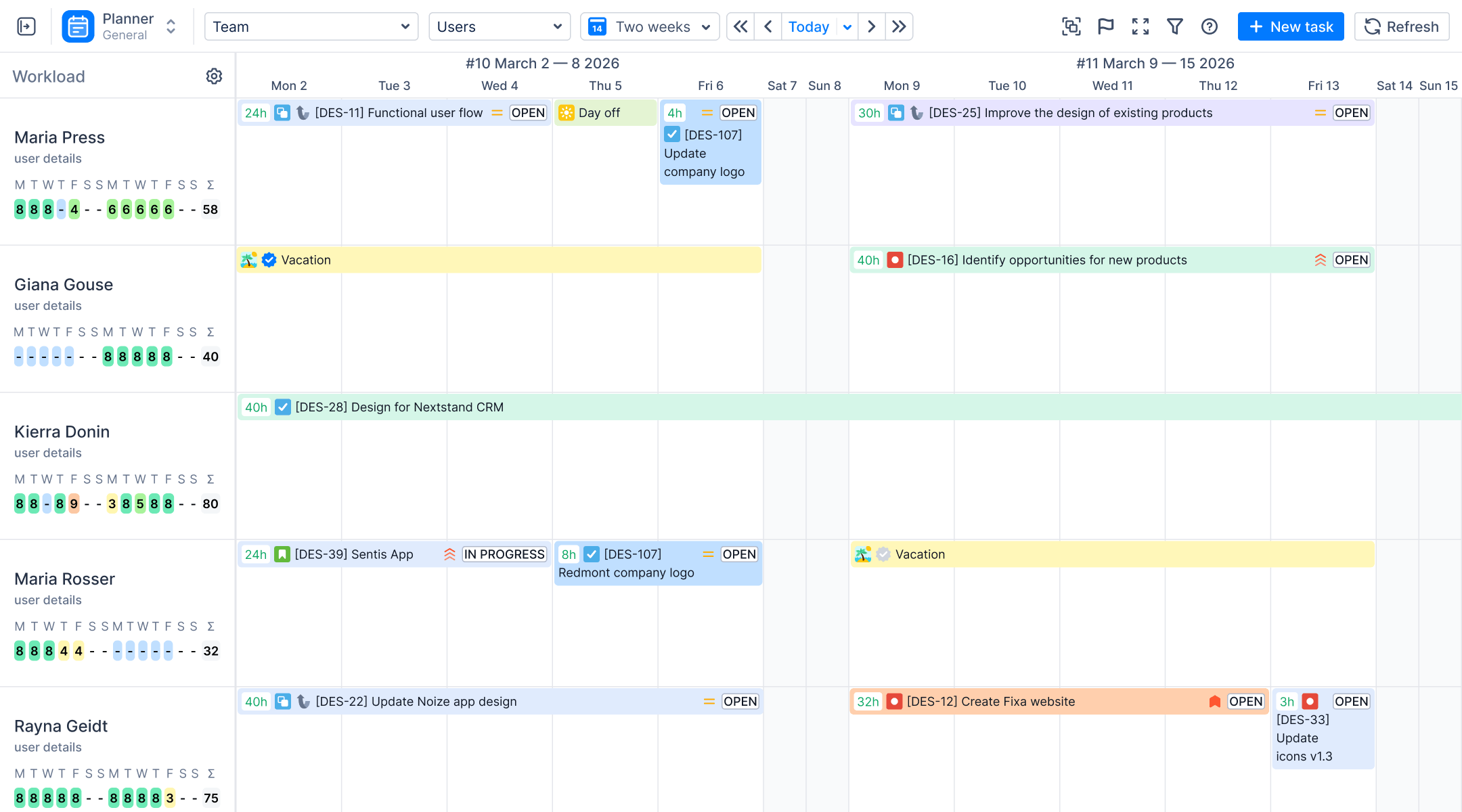
Ce rapport offre un aperçu complet de tous les événements liés aux congés, y compris les arrêts maladie, les vacances, les jours de congé et les demi-journées de congé, pour chaque membre de l'équipe. La fourniture de ces informations facilite la planification proactive, assure une charge de travail équilibrée et aide à prévenir l'épuisement du personnel.

Leave & Event Reports

Frequently Asked Questions

What reporting does ActivityTimeline offer that Jira doesn't have natively?
ActivityTimeline provides cross-project reporting, resource utilization forecasts, availability tracking, and planned vs. actual comparisons. It also tracks billable versus non-billable time, leave events, and allows full timeline exports to Excel.
Can I run reports across multiple Jira projects at the same time?
Yes, all reports support multi-selection from the Project dropdown or via saved JQL filters to cover your entire instance. This allows you to generate unified reports across several projects simultaneously.
How do availability reports differ from utilization reports?
Utilization reports show scheduled work as a percentage of capacity, while availability reports show the remaining free hours after work is subtracted. Availability can be viewed at the individual, team, or skill level to quickly find the right person for a new task.
How does the Resource Utilization Forecast calculate utilization?
The report divides utilized capacity (scheduled hours from Jira tasks and timeline bookings) by total available capacity (working hours minus time off). This generates a weekly utilization percentage to help identify upcoming resource overloads before they occur.
What is the Project Resources Forecast report used for?
This report shows exactly where individuals are spending their time across different initiatives over a specified timeframe. Displayed as a heatmap, it highlights heavy allocations to help answer which projects consume the most resources.
How does the Planned vs. Actual report define "On Track" or "Underestimated"?
The report compares original estimates against the combination of time spent and remaining estimates. Tasks are "On Track" if totals match within a custom tolerance, "Underestimated" (red) if they take longer, or "Overestimated" (yellow) if they finish faster than expected.
How does the Project Progress Report calculate completion percentage?
It calculates completion either by Time Spent (Worklogs divided by Worklogs plus Remaining Estimate) or by Issue Count. The data is organized hierarchically, allowing completion bars to roll up from individual issues to epics and overall projects.
Can I pull a report specifically for billable vs. non-billable client invoicing?
Yes, the Detailed Timesheet can group entries by custom categories like Billable and Non-Billable. For client invoicing, the Detailed Worklog Report neatly exports all records with timestamps, comments, and categories to Excel.
Can I group and filter reports by custom Jira fields?
Yes, the configuration panel for most tabular reports includes a Custom Fields selector. This allows you to group or add data columns based on corporate structures like Client, Cost Center, or Department.
How do I save report templates or share them with non-Jira users?
You can save configurations as bookmarks or Saved Dashboards and set access levels to Private, Shared, or Public. Sharing the generated report link carries the full configuration, allowing even non-Jira users to access the most current data.
How do I embed ActivityTimeline reports in a Jira dashboard or Confluence page?
You can embed live reports using the ActivityTimeline gadget within Jira dashboards. For Confluence, generate an Embed URL from the report template and paste it into an iFrame macro to display interactive, permission-aware data.
What formats do exports support and what data is included?
Every report features a one-click export to standard .xlsx format for use in Excel, Google Sheets, or LibreOffice. Exports contain structured data matching the report type, including detailed worklogs, utilization percentages, or full daily schedules from the planning dashboard.
Can I access report data programmatically via API?
Yes, ActivityTimeline provides a REST API that covers the main reporting data categories. Endpoints allow you to programmatically pull daily workloads, availability, total capacity, and specific worklog records.
Are there limits on how far back historical reports can go?
There is no hard cutoff, but calculations depend on available Jira issues and logged time. Issues exceeding the default 18-month "Ignore issues older than" limit may be excluded, though administrators can easily increase this threshold for deeper historical analysis.
Transformez les données en rapports faciles à comprendre
Commencez votre essai gratuit de 30 jours. Aucune carte de crédit n'est requise.
Planer | ActivityTimeline