BlogFeatures
Team Utilization Chart: Where Your Team's Time Actually Goes

Team Utilization Chart: Where Your Team's Time Actually Goes

ActivityTimeline’s Team Utilization Pie Chart provides a simple, powerful visual breakdown of your team's time allocation across different projects, epics, or even custom categories.

October 16, 2026
0
min read
Team Utilization Chart for Jira: See Where Your Team's Hours Go
Daria Spizheva | ActivityTimeline's Blog Author
Daria Spizheva
Content Marketing Manager
In this article

{{key-takeaways}}

Your team is at 95% utilization, and you still can't answer the question your director asked: how much of that went to the new product, and how much to keeping the old one alive? A utilization percentage says the team is busy. It doesn't say busy with what.

A team utilization chart in our Jira reporting answers that. It splits the team's hours into slices by project, epic or any Jira field, so you can see that 60% of last month went to maintenance before you promise the roadmap another quarter. Below is how to build one in ActivityTimeline, what it shows for past and future periods, and where it stops being useful.

The High Cost of Flying Blind

When you can't easily see your team's workload distribution, every decision is a gamble. You might approve a new project thinking you have the capacity, only to discover your most critical team member is already spending 60% of their actual hours on maintenance tasks. This is how scope creep happens, how burnout becomes inevitable, and how even the best project managers end up missing deadlines.

Standard utilization reports often fail to provide the context you need. They might tell you if your team is busy, but not what they are busy with. This lack of insight makes it impossible to improve resource utilization or have meaningful conversations about priorities.

{{rich-cta-1}}

What is a team utilization chart?

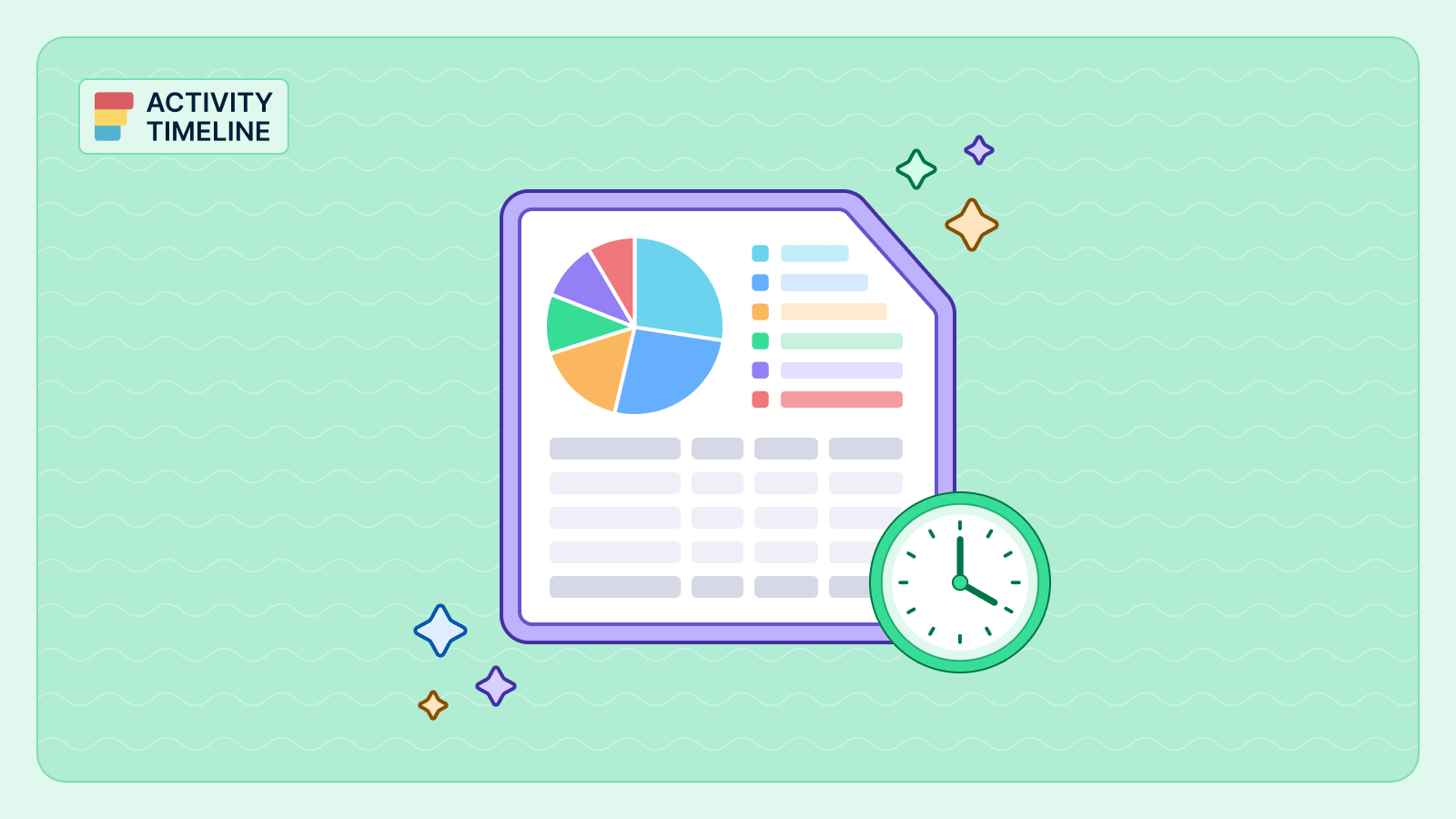
A team utilization chart is a pie chart of one team's time over a period, split by project, epic or another Jira field. Each slice shows hours and a percentage of the total. In ActivityTimeline it's called the Team Utilization Pie Chart, and it can use logged time for a past period or planned work for a future one.
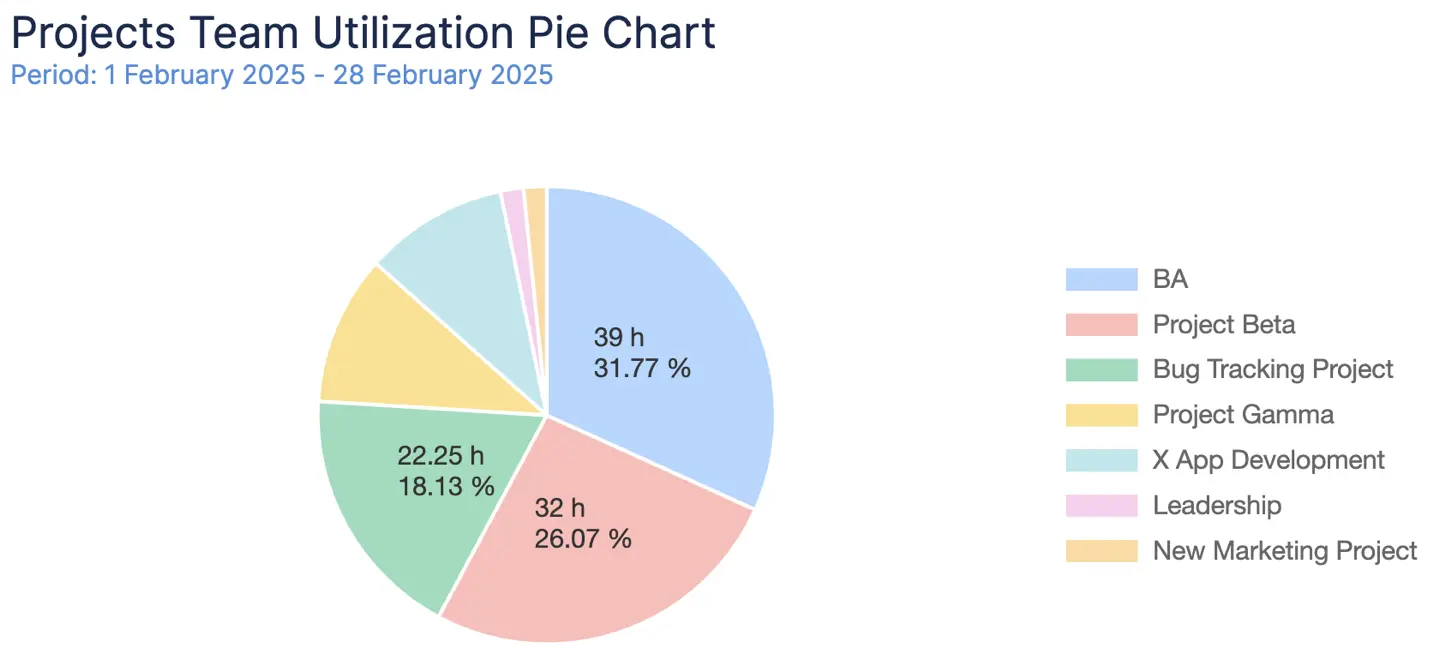
A clean and vibrant screenshot of the ActivityTimeline Team Utilization Pie Chart showing time distributed across four different projects.

How to create a team utilization chart in ActivityTimeline

  1. Open Reports and choose Team Utilization Pie Chart.
  2. Set Reporting Scope: past (worklogs) or future (estimates and bookings).
  3. Pick the Period, for example last month or the next 10 weeks.
  4. In Report By, keep all scheduled work, or choose Jira Filter and pick a saved filter to limit the data.
  5. Choose the team or people.
  6. In Group By, choose Project, Epic or a Jira custom field, and click Create.
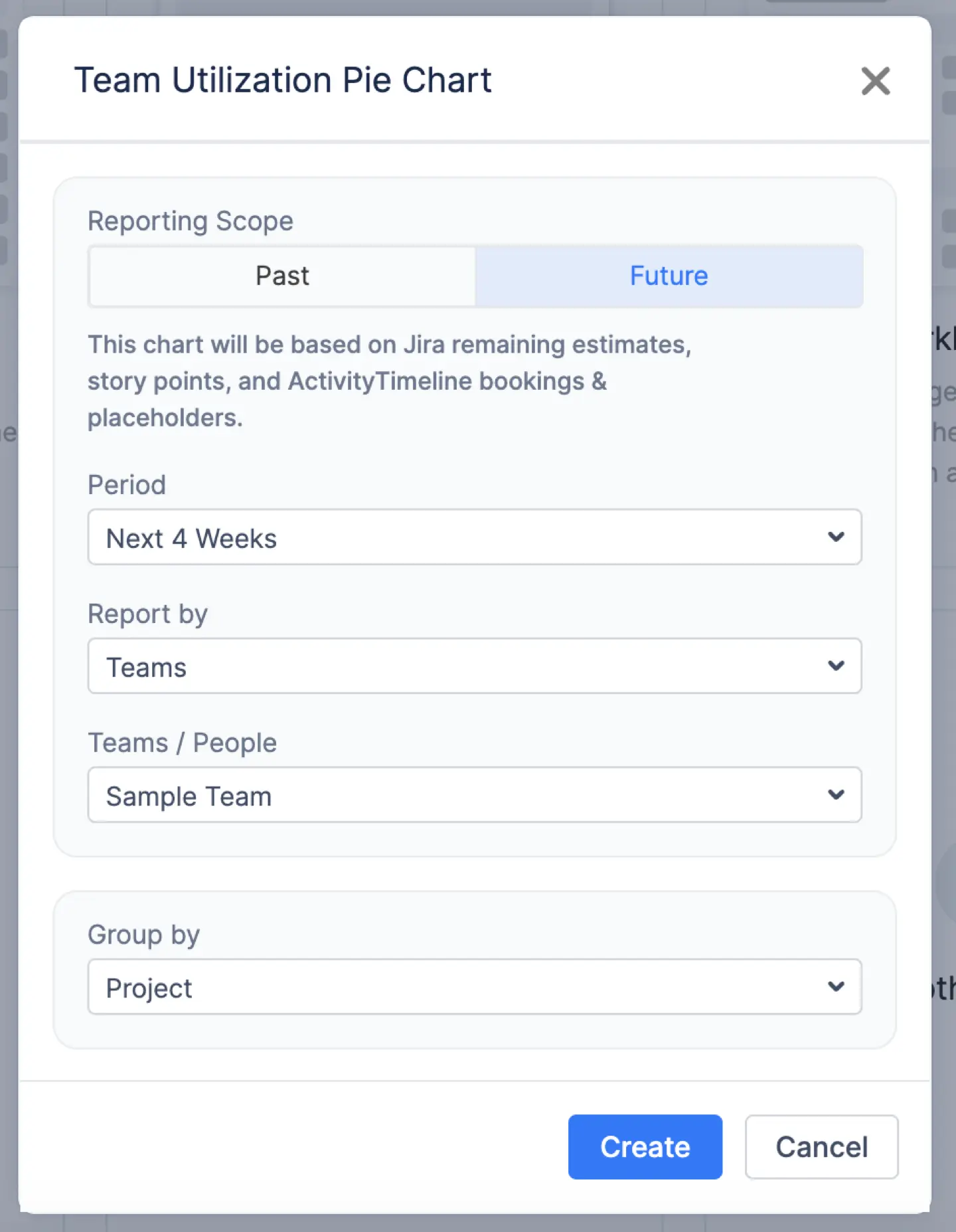
Chart generation popup

After it's built, the settings button at the top right lets you change the team, the period or the filter, switch Jira issues, bookings or placeholders on and off, and show percentage.

Can the chart show past and future utilization?

Yes. The Reporting Scope of our utilization report decides which data goes in:

Scope Data used Use it for
Past (worklogs) Logged work, bookings and imported calendar events Retrospectives, quarterly reviews, "where did the time go"
Future (estimates) Remaining Jira estimates, bookings, placeholders and imported calendar events Checking a plan against priorities before it starts
  • Analyze the Past (Worklogs): By selecting "Worklogs" as your data source, the report analyzes historical time tracking data. It pulls all logged time, bookings, and imported calendar events to show you exactly how your team's actual hours were spent during a completed period. This is perfect for sprint retrospectives and performance reviews.
  • Forecast the Future (Estimates): Switch the scope to "Estimates," and the chart transforms into a forecasting tool. It uses the remaining estimates on Jira issues, future bookings, and placeholders to predict how your team's time will be allocated in an upcoming period. This allows you to spot potential resource conflicts long before they happen.

The future view is the one that saves you trouble. If next quarter's chart shows 45% on a project the business called low priority, you can change the plan now instead of explaining it in three months.
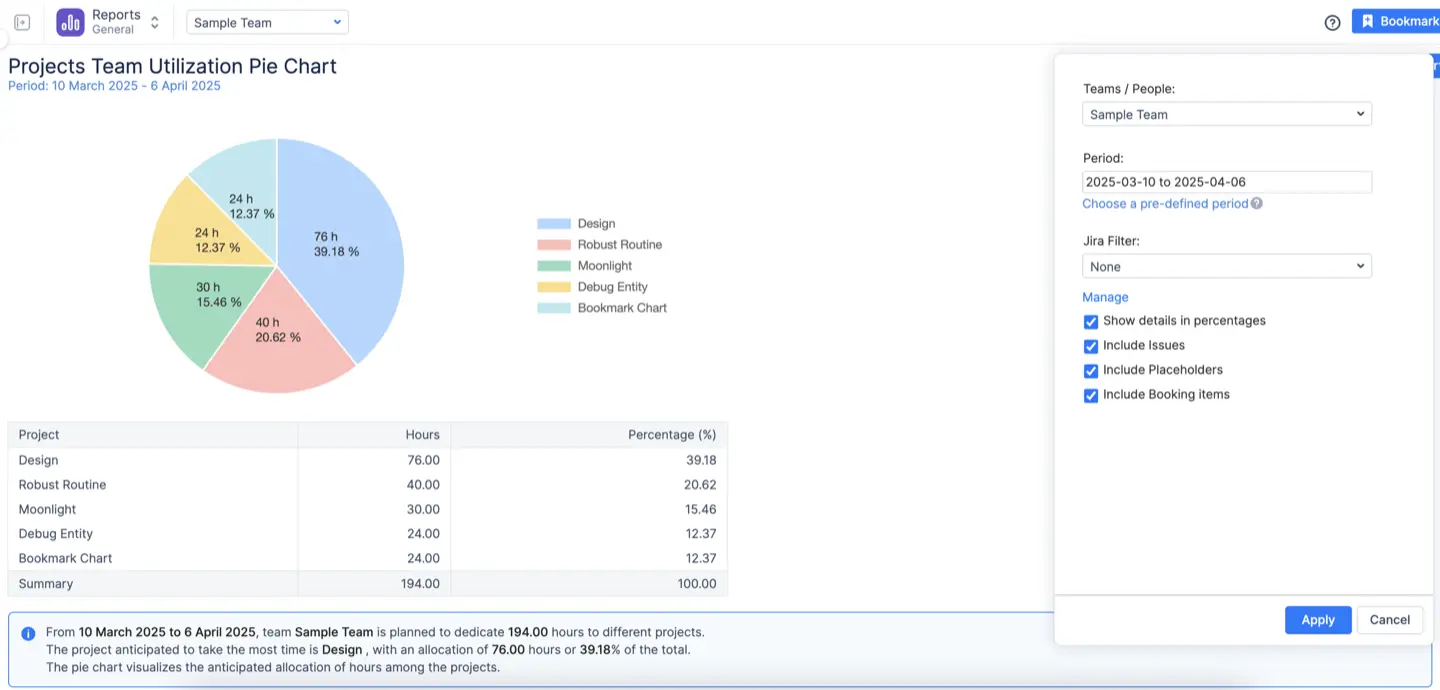
A screenshot of the report's configuration options

How to group the chart by project, epic or custom field

Project is the default grouping and answers "which projects take our time". Epic shows larger initiatives across projects. Jira custom fields (available since version 10.2) let you group by anything your team tracks, for example Issue Type, to see whether time goes to bugs, improvements or new features.

To narrow the data first, use a Jira filter in Report By, for example only issues with the labelclient-a

Jira pie chart gadget vs ActivityTimeline utilization reports

Jira Pie Chart gadget Team Utilization Pie Chart Team Capacity Chart
Measures Number of issues Hours Hours vs available capacity
Past and future Current state of the filter Both Future
Includes bookings, meetings, placeholders No Yes Yes
Answers "How many issues per status or assignee?" "Where do our hours go?" "How full is the team?"
Cost Included in Jira ActivityTimeline ActivityTimeline

The Jira gadget is fine when issue counts are what you need. It can't tell you that 12 small bugs took more time than one large feature.

One honest limit: the utilization chart shows distribution, not efficiency. A team can spend 50% on the right project and still deliver half of what was planned. For that, compare planned and logged hours in the Planned vs Actual report.

{{rich-cta-2}}

TL;DR

You think you know what your team is working on, but you're flying blind. Standard Jira time tracking reports are just data dumps, offering zero at-a-glance insight into where your most valuable resource - your team's time - is actually being spent. With ActivityTimeline’s Team Utilization Pie Chart, make sharp, data-driven decisions in seconds. Instantly see if you're spending 40% of your time on low-priority bugs, justify resource needs with accurate data, and align your team's effort with strategic goals. Toggle the reporting scope to analyze past performance (using Worklogs) or forecast future workloads (using Estimates). Group the data by project or epic to get the exact comprehensive view you need for your next planning session.

Key takeaways

  • A team utilization chart shows how a team's hours split across projects, epics or any Jira field, as hours and percentages.
  • The Team Utilization Pie Chart in ActivityTimeline looks back at logged work or forward at estimates, bookings and placeholders.
  • Jira's own Pie Chart gadget counts issues by field; it doesn't split hours.
  • The chart shows distribution, not efficiency: to see whether people delivered what was planned, use the Planned vs Actual report.
  • You can build one on your own Jira data with a 30-day free trial.

Tired of your team's time being a black box?

See exactly where every hour goes with a free trial of ActivityTimeline.

ActivityTimeline Illustration

Ready to make smarter, data-driven decisions?

Schedule a personalized demo to see the Team Utilization Pie Chart in action.

ActivityTimeline Illustration
Join 2500+ people getting bi-monthly newsletter:
Event and webinar invitations
Project management tips
<0.3% unsubscribe
Free, forever
Thank you! 🙏🏻
Your submission has been received!
Oops! Something went wrong while submitting the form.

Frequently Asked Questions

Is there a way to export the Team Utilization report to Excel?

Currently, a direct Excel export option for the Team Utilization Pie Chart is not available. However, this is a known feature request, and the development team is working to include it in a future update.

Is there a limit to how much historical data can be included in a single utilization report?

Yes, the Team Utilization report is currently limited to three months of data per report to ensure optimal performance. To analyze data over a longer period, such as six months, you would need to generate two separate reports.

Can the report roll up data based on custom fields like "Project Category"?

At present, the report does not directly support rolling up data based on custom fields like "Project Category." A potential workaround is to generate separate reports for each unique value in your custom field and then manually consolidate the data. The development team is working on adding more flexible reporting options.

What should I do if the pie chart legend is truncated or partially hidden?

This can occasionally happen with various visual reports. A common and effective workaround is to simply zoom out in your web browser. If the issue persists, contacting the support team with details about your browser and operating system can help troubleshoot the problem.

Does this report indicate the efficiency of the team?

No, it's important to understand that the Team Utilization Pie Chart only shows the time distribution across projects. It does not measure the actual efficiency or team performance. It answers "Where did the time go?" not "How well was the time used?".

Still have questions about ActivityTimeline? Get in touch
Your most organized Jira workflow is just a click away
Start your 30-day free trial. No credit card required.
Planer | ActivityTimeline