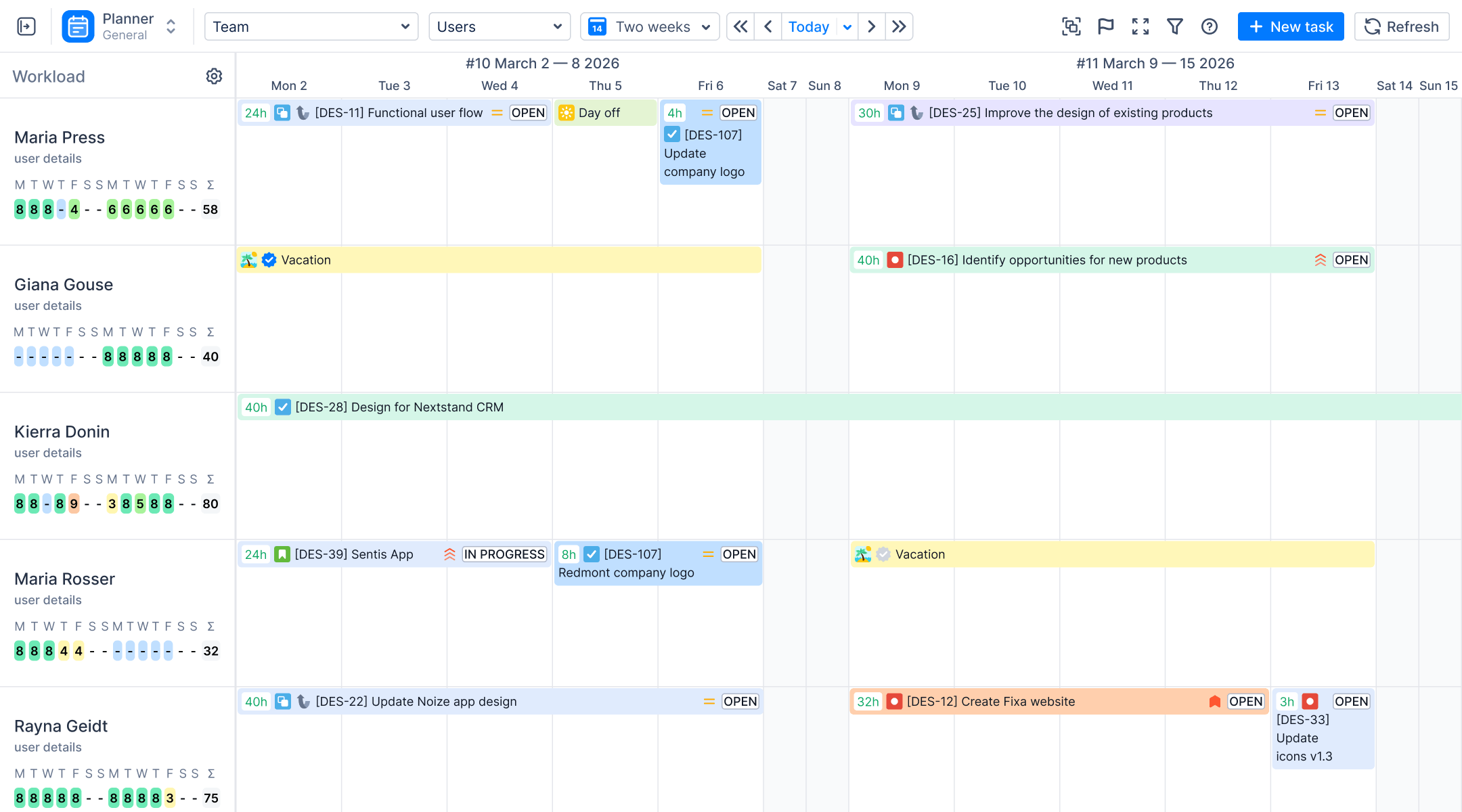
Now, resource management might sound like it’s all about budgets, but it’s really about your team—the people who bring the project to life. Good resource management is about figuring out how to bring out the best in your employees, teammates, or coworkers by ensuring you have the appropriate resources for successful project outcomes.
Just relying on estimates or gut feelings isn’t going to cut it. When done right, resource management lets you smooth out workflows, actually understand each person’s work capacity, and create a space where everyone feels more engaged and helps boost productivity.
In this piece, we outline how effective resource management helps your team thrive because you’ll know what motivates them and how to balance their workload to keep productivity high.
{{key-takeaways}}
Understanding Resource Management
Simply put, the resource management process is all about planning and divvying up your resources in a way that gets the best results. It’s about assigning tasks and projects without pushing your team to the brink of burnout.
A key concept in resource management is the “iron triangle”, which includes three must-have ingredients for project success:
- Budget
- Schedule
- Scope
These three are tightly linked, so changes to one affect the others. For instance, if your budget takes a cut, your project timelines might also shift because you’ll have fewer resources to keep things moving. If the scope of the project expands or shrinks, expect the budget to adjust right along with it.
In real-life scenarios, let’s say you assign three employees to a project, each working three hours a day for a week. But if one of them suddenly falls ill, you have to deal with limited resources. The whole plan needs adjusting.
So, why bother with good resource management? It helps you avoid these hiccups and keep things on track so your team stays productive and projects run smoothly.
Benefits of Efficient Resource Management
An effective resource management strategy is essential for successful project execution, as it involves planning, scheduling, and allocating resources to maximize efficiency.
Keep Projects on Track
When you start refining your resource management, you’ll instantly notice how much easier it is to stay on top of each project. Having a clear snapshot of all active projects and available resources gives you a serious advantage in tracking progress—and spotting issues early. Plus, well-managed resources mean less stress and more momentum for your team, especially when it comes to using people’s skills to their full potential.
Cut Down on Time Wasters
Effective resource planning saves time by avoiding those annoying bottlenecks and project delays. With the right tools and strategies, you can set up workflows that help everyone focus on the tasks at hand, cutting down on delays and making sure each project runs more smoothly.
IMCD Group, a global chemical distributor, implemented ActivityTimeline to standardize time tracking across its rapidly growing IT department. By moving away from inconsistent logging, the company gained clear visibility into which specific projects and tickets were consuming resources.
This change significantly streamlined operations, reducing the time required to sign off on invoices from five minutes to just one minute per consultant. These efficiency gains save each manager over five hours every month, allowing them to focus on high-level decision-making instead of administrative tasks.
Smarter Forecasting and Capacity Planning
Resource management isn’t just about what’s happening now; it helps you forecast future needs and plan for future projects too. By knowing your team’s resource capacity and having a solid plan, you’ll get better at hitting deadlines, even as projects scale up. This can make life so much easier down the line, as you’ll have a blueprint for long-term success.
Boost Employee Engagement
The numbers don’t lie. According to the State of the Global Workplace: 2026 Report, only 20% of employees globally are engaged. 64% are not engaged, and 16% are actively disengaged. A good chunk of this is tied to unclear expectations and feeling underutilized. This disengagement costs the world economy about $10 trillion annually in lost productivity. That equals 9% of the global GDP.
However, effective resource management can flip the switch by helping each team member feel their time and skills are used meaningfully. When people are managed well and given a say in their workload, they’re less likely to feel burnt out and way more likely to bring their A-game to work every day.
Leveraging Technology for Resource Management Software
If you’re trying to handle resources like a pro, there’s a straightforward solution: let resource management software do the heavy lifting. Resource management tools help you streamline tasks, track progress, and clear up your schedule for big-picture planning. And since remote work is here to stay, tools that give you real-time visibility, like cloud-based schedulers, are the way to go.
Jira is essentially helpful for organization collaboration. Moreover, users are welcome to improve their work & operations with the help of third-party add-ons for Jira available at the Atlassian Marketplace. In the Atlassian Marketplace you can find numerous tools for various needs. These tools will help you make advanced decisions and stay on the same page with your team members in real-time:
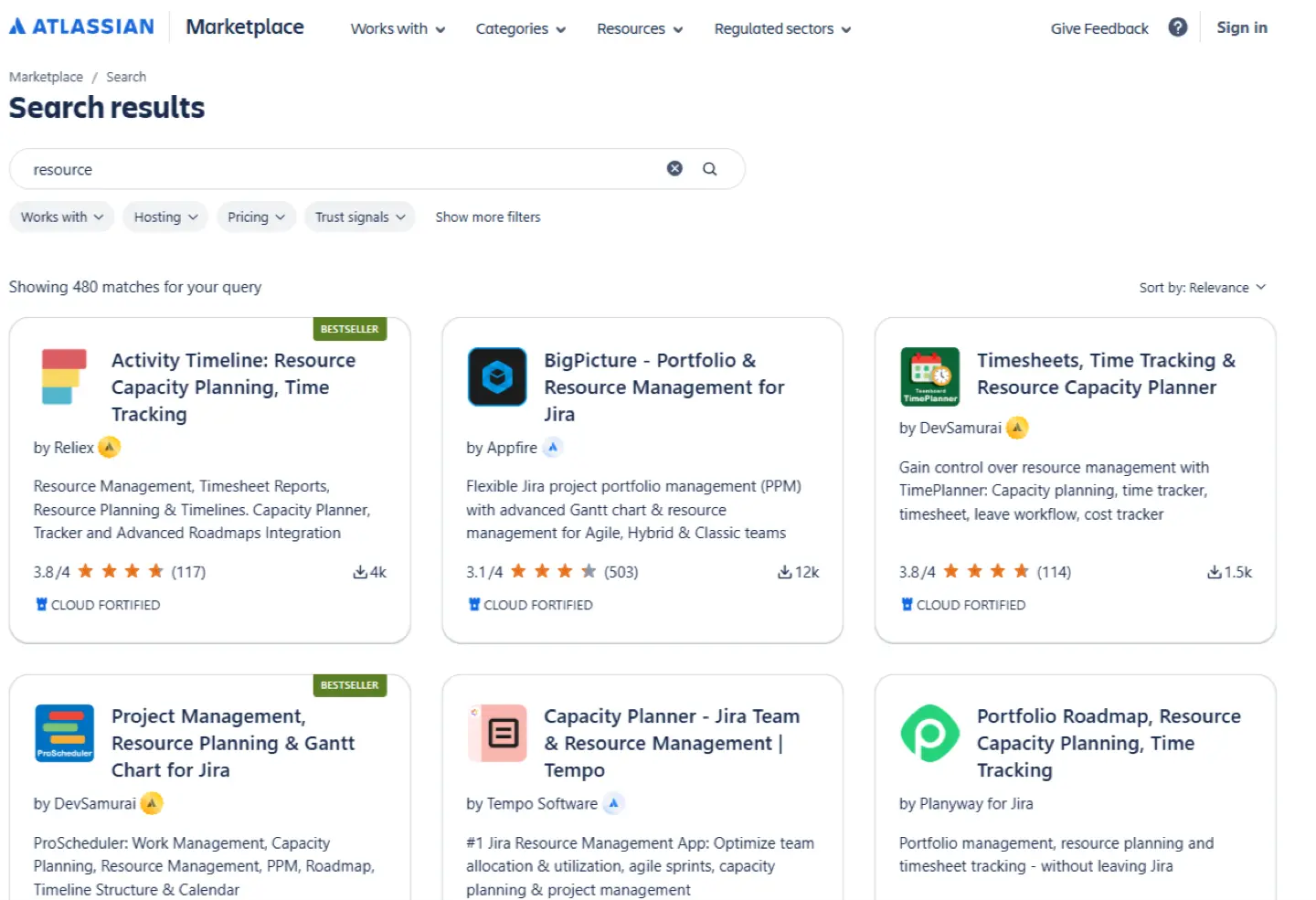
Resource Management and Tracking with Activity Timeline
ActivityTimeline is a popular resource planning and project management tool for Jira. To keep it simple, tools like Jira and ActivityTimeline are a killer combo. With Jira, you can assign tasks, check progress, and see clear metrics on who’s done what. Add in ActivityTimeline, and you’ve got a resource planner that helps you organize around real-life stuff like vacations, sudden sick days, and everyone’s unique strengths.
ActivityTimeline makes teamwork smoother by letting people swap tasks, drop comments, and communicate directly in the tool. Need someone with a specific skill on a project? No problem—assign it to the right person without a hassle.
It’s all about setting up your team for success while keeping things moving in the right direction:
#1. Get a Clear View of Who’s Doing What and When
ActivityTimeline makes it super simple for a project manager to see who’s working on what and when it’s due. The tool’s cross-project dashboard lets you see all tasks and multiple projects in one place, with timesheets, resource reports, and an overview of each team member’s workload—all synced up with Jira.

The dashboard also integrates with Google Calendar and Outlook to show external meetings alongside Jira tasks. Here is how you can import events from Google Calendar to keep your schedule accurate:
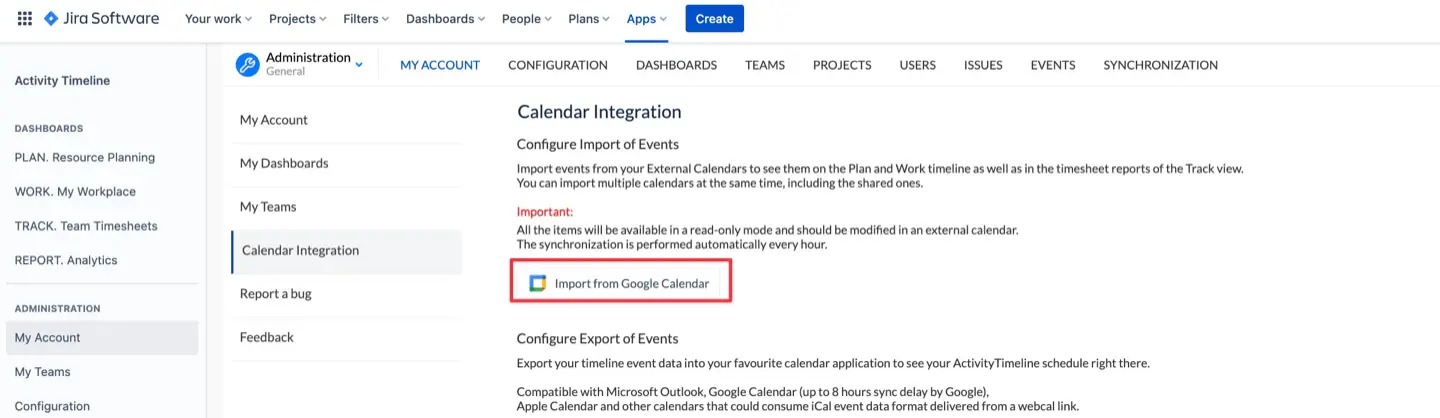
#2. Assign and Track Tasks in a Snap
With ActivityTimeline, you can assign existing Jira tasks or create new ones right from the app’s Plan view. It’s built for everything from task scheduling to smart resource allocation and prioritizing jobs, so you can get more done with less stress.

#3. Manage Time Off, Skills, and Custom Resources
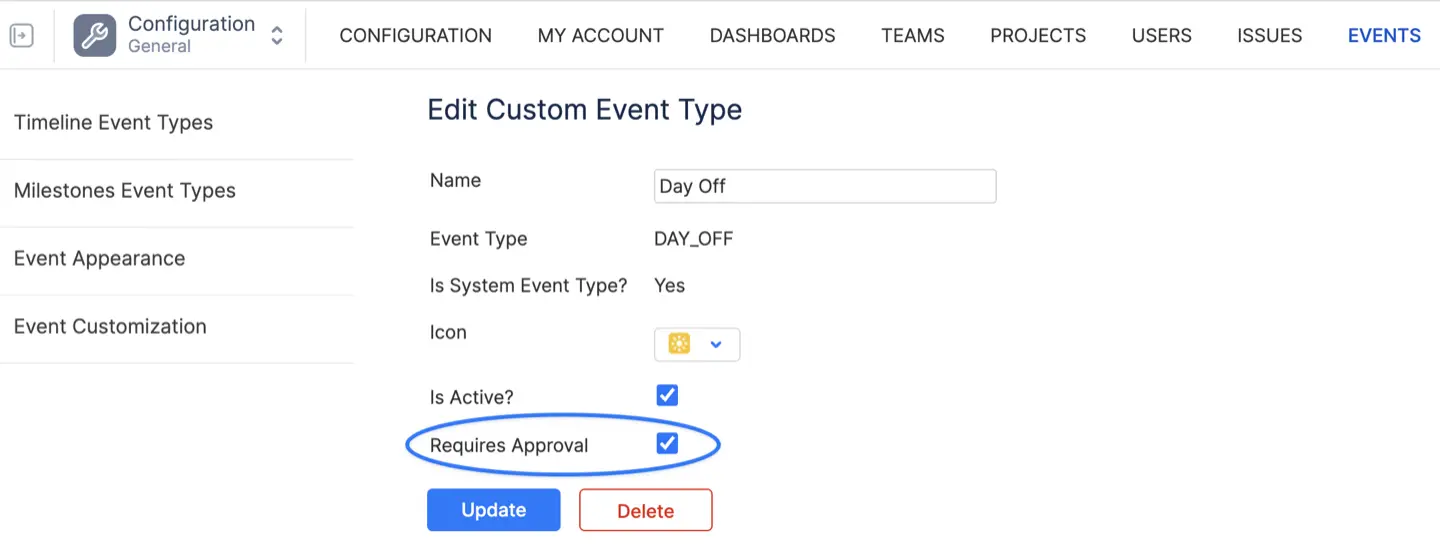
Human resource management is crucial for tracking vacations, sick leave, and other custom events. ActivityTimeline makes this process easy. You can even create custom resources (like non-human assets) and ensure that every skill gap is covered when the project needs it.

The tool also supports leave approval workflows and custom vacation cycles. Here is how to enable or disable approval for custom events:
#4. Keep an Eye on Workload and Availability
ActivityTimeline comes with workload indicators that show resource availability. So you can see who’s overbooked and who’s got time to spare. Your timesheets and worklogs can even show time in days instead of hours if you enable this feature.
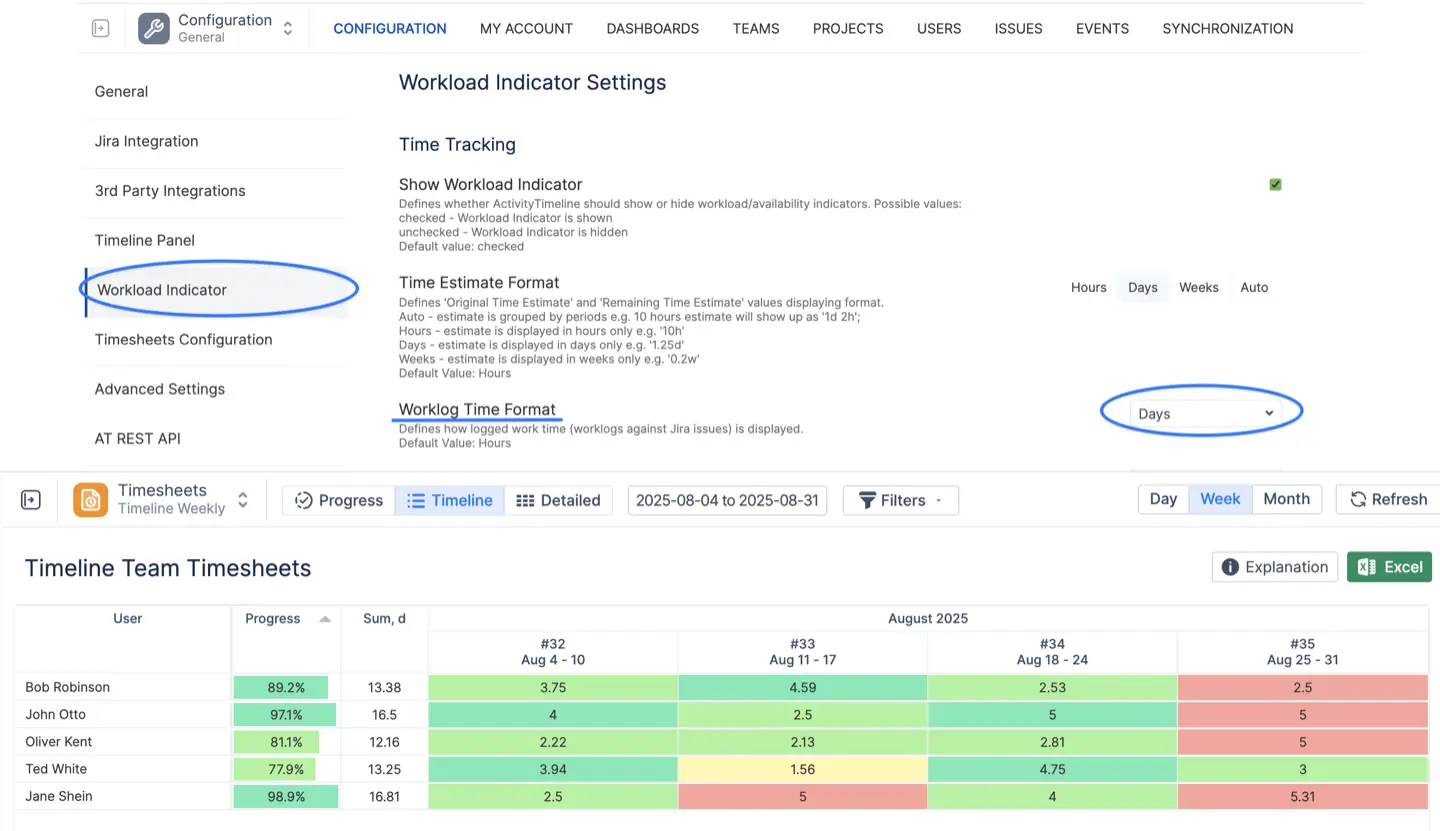
You can set custom workload schemes and task assignments for specific users or even whole teams. This helps you balance everyone’s workload so nothing falls through the cracks and projects stay on track. You can view on the Planner timelines of the team, individual users, or multiple single users.
ActivityTimeline allows you to customize calculation modes to provide insights matching your goals better:

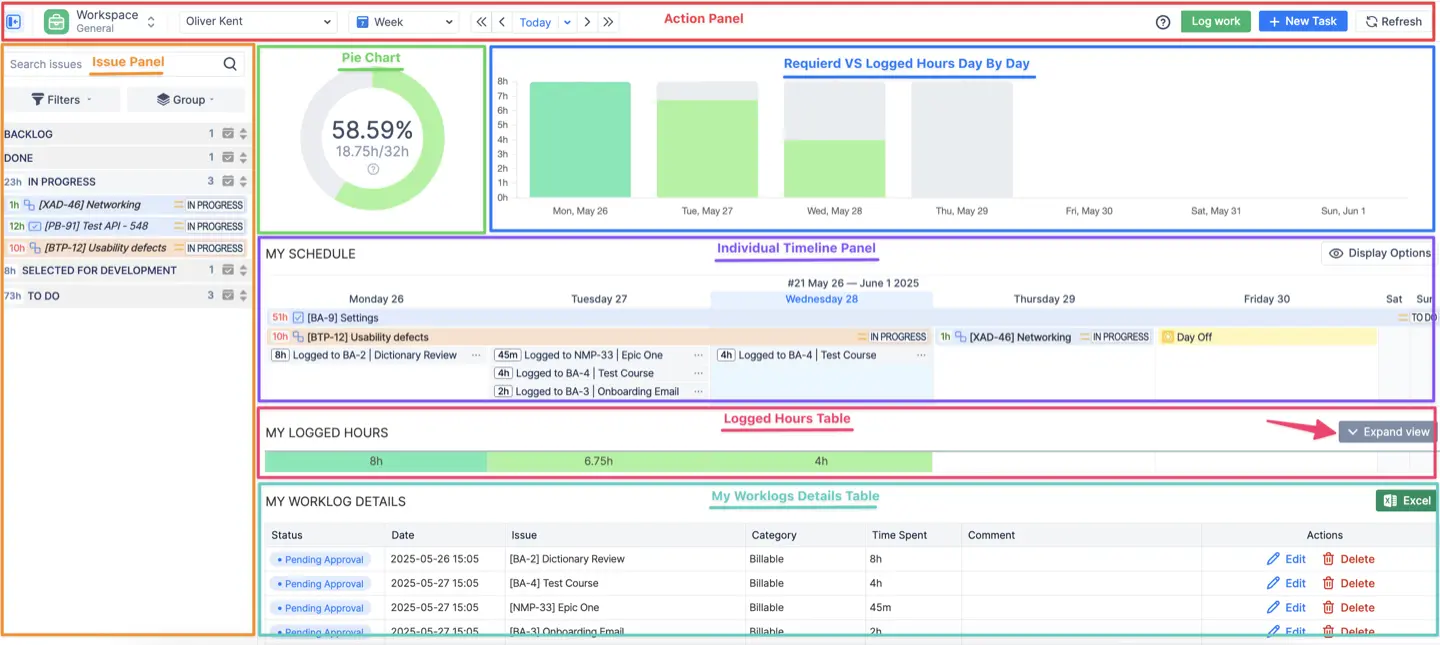
#5. Personal Workspaces for Easy Time Tracking
Every team member gets a personal workspace to view tasks, log hours, and request time off. ActivityTimeline’s simple time-tracking features let users log work in a few clicks and even use a timer for precise tracking, so they’re focused on their work—not on filling out timesheets. You can daily work log directly from the native Jira issue view, and managers can log time on behalf of others.
#6. Track Time with Timesheets
Of course, great resource management tools offer Timesheet tracking, and ActivityTimeline is no exception. All the available data and logged time can be used for the creation of the advanced team timesheets built like a constructor for user convenience. Choose the data needed and generate tracking reports:
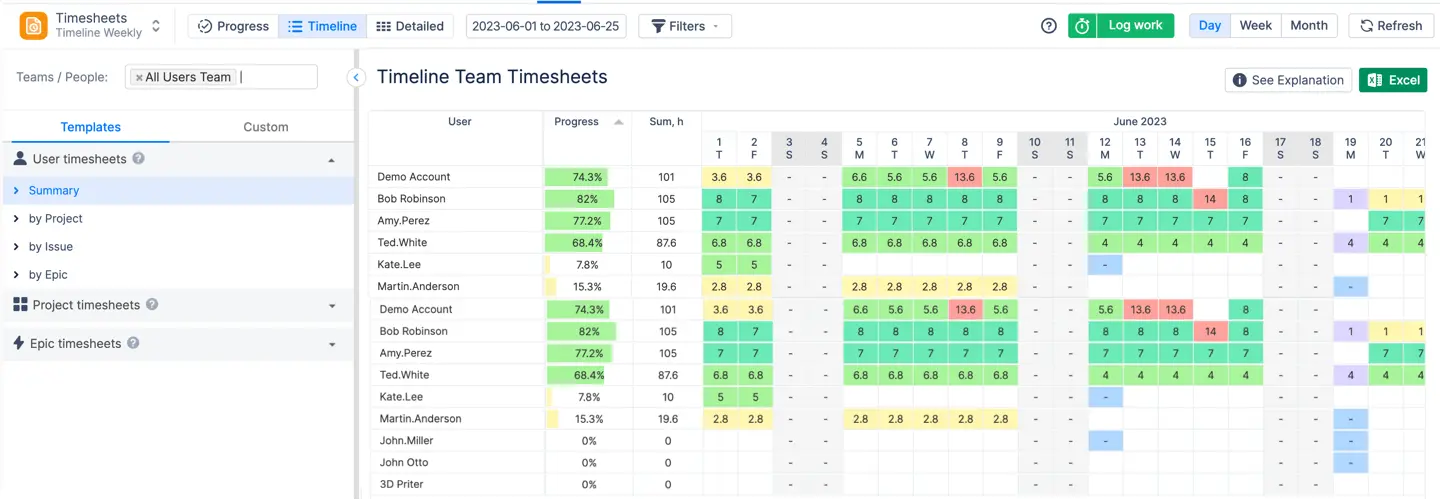
You can also monitor how your teams are progressing using real time data from the progress report.
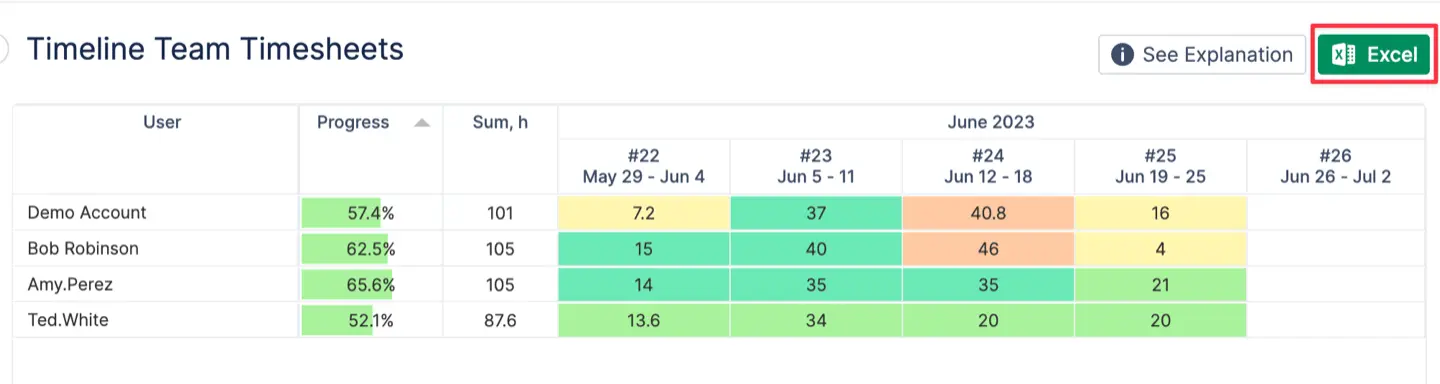
For your convenience, all timesheet reports can also be exported like an Excel file.
#7. Advanced Reporting for Better Insights
ActivityTimeline’s reporting tools for Jira let you create detailed reports on resource efficiency, resource use, project progress, and task completion.
Managers can group data by Position or custom fields for more profound analysis. You’ll see where resources are stretched too thin or could be better used, with export options in Excel format for reports like Resource Utilization and Availability. Here are some of the most actively used in effective resource management:
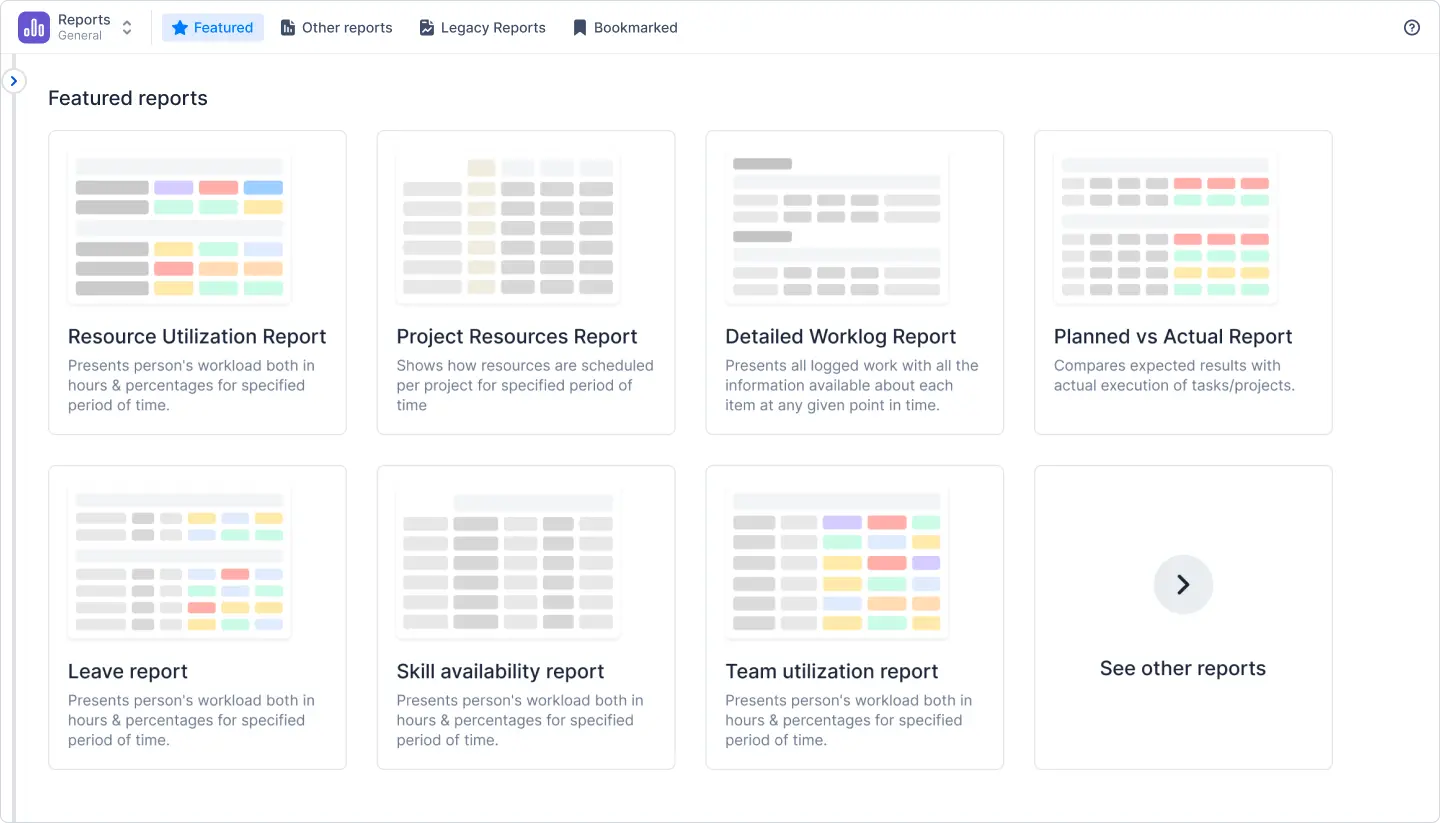
The Resource Utilization Forecast breaks down where time and effort are going, showing you who's working hard and who might be sitting idle. This report helps you spot any imbalances, so you can make tweaks to ensure everyone’s skills are put to good use without anyone feeling overwhelmed.

The Team Capacity Chart gives you a visual snapshot of your team's workload and availability. It helps you see who's got room for more tasks, making it super easy to balance assignments.

Managers can group this chart by Issue, Epic, or Custom Field. Crucially, they can include or exclude workloads for specific users versus the overall team panel, allowing them to switch instantly between high-level team forecasting and individual capacity. With this chart, you can quickly identify gaps in your team's capacity and adjust plans on the fly.
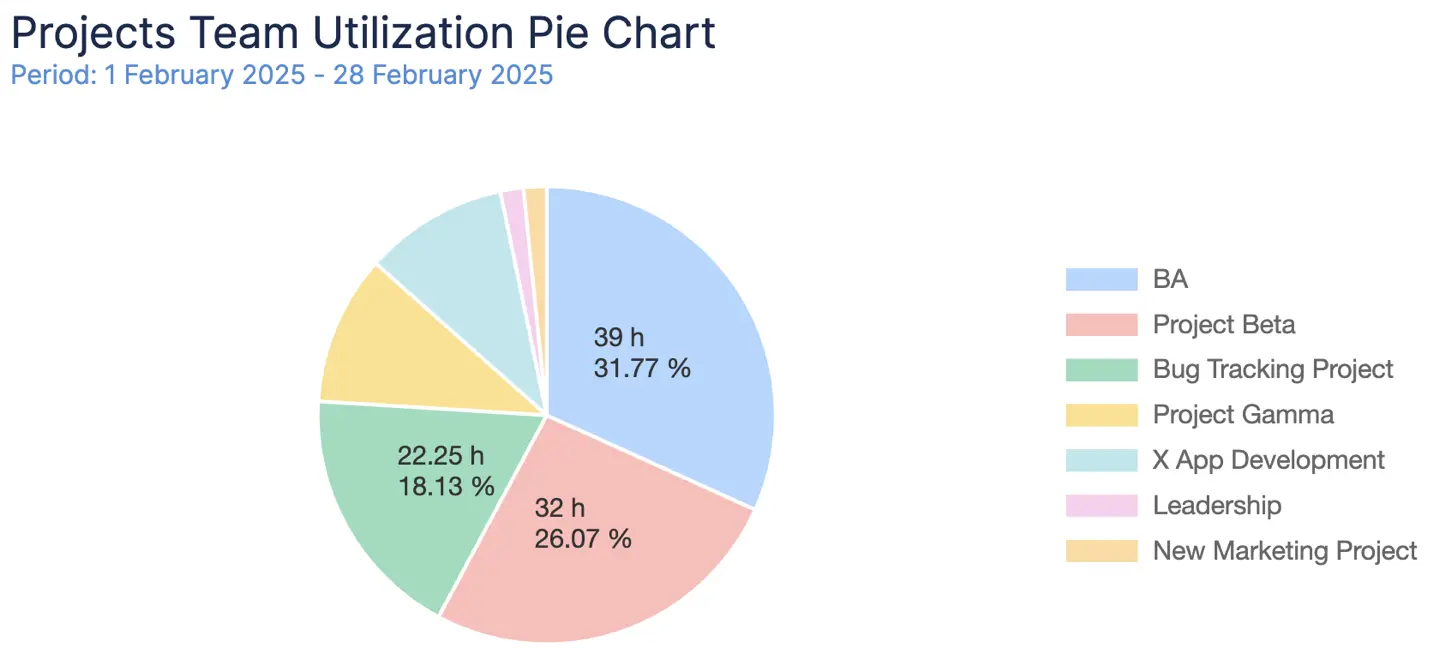
The Team Utilization Pie Chart serves up a fun, easy-to-read visual representation of how your team’s time is divided among various tasks. This chart helps you celebrate wins by showing where the bulk of your team’s energy goes while also pointing out areas that might need more attention.
The Project Progress Report gives you a clear view of how your Jira projects, epics, or initiatives are moving along. It organizes everything in a hierarchy so you can see how individual sub-tasks impact the bigger picture. You can calculate progress based on the number of completed issues or by comparing estimates with logged work. You can also adjust your filters and calculation methods instantly to get the overview you need.
Best Practices for Resource Management
Resource management involves making smart choices so that a resource manager can ensure everyone and everything works smoothly.
Here are some key moves:
#1. Nail Down What You Need
First, list all the project resources you’ll need: people, tools, and supplies. Then, rank them based on what’s essential and what you already have. It’s all about covering your bases upfront so nothing’s missing when needed.
#2. Assign the Right People to the Right Tasks
Match people’s skills and interests to their tasks to get the best results. Tools like ActivityTimeline make this much easier by showing everyone’s availability, skills, and workloads in one place, so you’re not left guessing. And remember: as projects shift, so should assignments, so check in often to keep things flexible.
#3. Maintenir une communication ouverte
Une bonne gestion des ressources est un effort d'équipe. Assurez-vous que chacun connaisse son rôle et maintenez le dialogue pour identifier les problèmes rapidement. Des outils comme Slack ou Teams permettent à tous de rester informés des mises à jour, des retours et des nouvelles du projet. Ainsi, vous aurez moins de surprises et plus de solutions.
#4. Prenez des décisions éclairées grâce aux données
Examinez les données des projets passés pour identifier ce qui a fonctionné et ce qui n'a pas fonctionné, en particulier en matière de gestion des ressources financières. La plupart des outils de gestion des ressources intègrent des fonctionnalités de reporting pour vous aider à mieux planifier l'avenir. ActivityTimeline offre une suite robuste de fonctionnalités de reporting qui permet une analyse multi-niveaux, une meilleure prévision des capacités et une évolutivité à l'échelle de l'entreprise. Les décisions basées sur les données réduisent les incertitudes et améliorent les résultats.
Conclusion
Maîtriser une gestion efficace des ressources, c'est comme établir la colonne vertébrale de tout projet réussi. Lorsque vous savez comment prioriser les ressources, attribuer les tâches efficacement et maintenir une communication fluide, l'ensemble du projet se déroule plus harmonieusement. Exploiter les bons outils et les bonnes pratiques de gestion des ressources signifie également que vous pouvez rester agile, mieux planifier et atteindre vos objectifs plus rapidement. En fin de compte, suivre ces pratiques aide votre équipe à gérer efficacement les ressources et à rester prête pour un succès à long terme.